

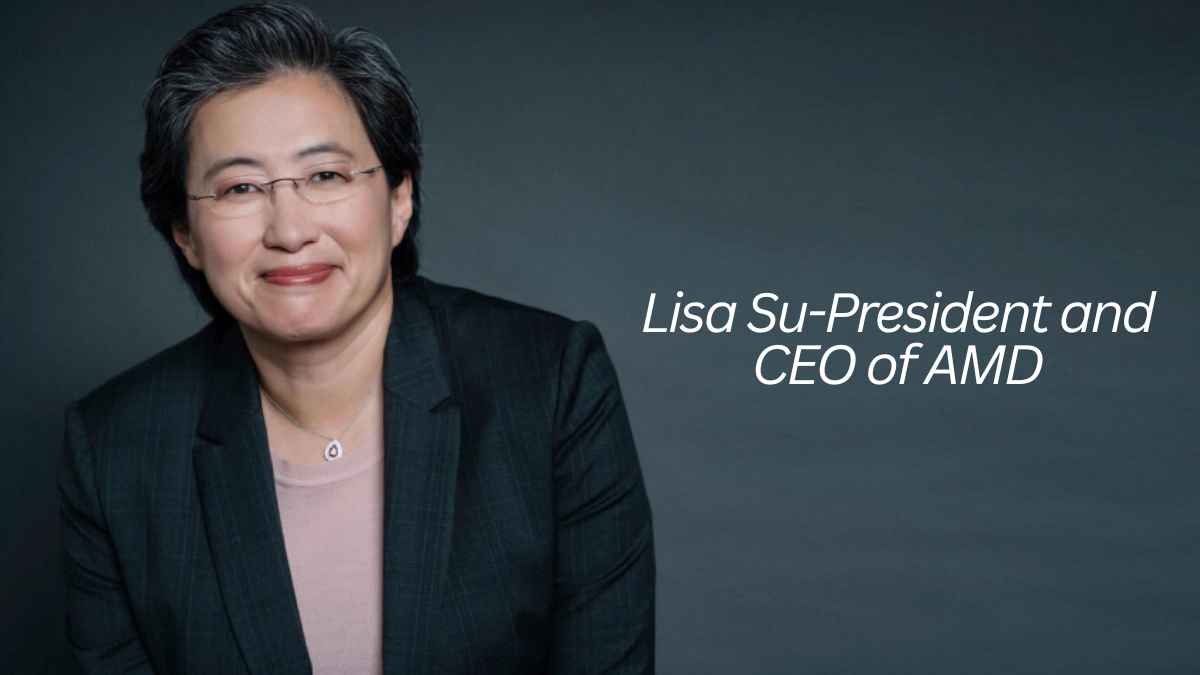
Silicon Valley’s next technology war is being waged not just in software, but in silicon. Semiconductor firms are now driving the region’s technology economy, as AI is creating an unprecedented need for computing power. Few executives are more closely associated with this shift than Lisa Su, President and CEO of Advanced Micro Devices (AMD).
Su is a particularly important figure in the evolution of the technology industry, for Silicon Valley Weekly. Her career sits at the intersection of engineering, semiconductors, artificial intelligence and business strategy. Under her leadership, AMD has emerged as a major player in high-performance computing and AI, putting the company at the center of a global race to build the infrastructure that will power the next generation of technology.
Who Is Lisa S. Su?
Dr. Lisa Su is an electrical engineer and semiconductor executive with deep experience in research, engineering, operations and corporate leadership.
She joined AMD in January 2012 as Senior Vise President and General Manager of the company’s Global Business Units. She later became chief operating officer, and was named president and CEO in October 2014. She was appointed chair of AMD’s board in February 2022.
Prior to joining AMD, Su served in senior positions at Freescale Semiconductor and spent 13 years in semiconductor research and development at IBM. She previously worked at Texas Instruments earlier in her career.
Her academic training is also of a technical character. Su holds the bachelor’s, master’s, and doctoral degrees in electrical engineering from the Massachusetts Institute of Technology.
Why Lisa Su Is Important to Silicon Valley
Silicon Valley has long been synonymous with software, internet companies, venture capital and start-ups. But the AI era is showing the importance of a more basic thing: computing hardware.
At the end of the day, all major artificial intelligence systems depend on chips, memory, networking, data centers and energy. Hence, we are witnessing semiconductor companies emerge as strategic players in the same technology ecosystem that has traditionally been dominated by software.
Su’s leadership at AMD is a reflection of that changing landscape.
The modern technology industry is increasingly treating advanced chips not simply as components inside computers, but as foundational infrastructure for AI, cloud computing, gaming, autonomous systems and other emerging technologies.
Turning AMD into a High-Performance Computing Powerhouse
During her tenure at AMD, Su has overseen a major strategic shift.
AMD describes its business as high-performance and adaptive computing with operations in data centers and AI, client computing, gaming and embedded systems.
The company’s evolution is important because competition among semiconductor makers determines what capabilities cloud providers, enterprises, PC makers, gaming companies and AI developers will have access to.
Su’s engineering background gives her a uniquely technical view on these challenges. At the same time, the role requires her to make long-term decisions on markets, manufacturing, partnerships, investment and competition.
That combination has become more valuable as AI pushes the semiconductor industry into a new phase.
Lisa Su and the race for AI chips
Now, artificial intelligence has become one of the main drivers of the semiconductor rivalry.
AMD is trying to expand its role in AI computing with products designed for demanding data-center workloads and initiatives to create a broader computing ecosystem around its hardware.
The scale of the opportunity was most apparent in September 2026 when AMD’s market cap crossed $1 trillion as investor enthusiasm around AI demand swept through the market.
But market value alone is not what defines a successful technology strategy.
The company has to continue to ship competitive products, while scaling out manufacturing capacity, software capabilities, customer relationships and the infrastructure to deploy AI at scale.
The Bigger Problem: Building the AI Infrastructure
The race for AI semiconductors is about more than just designing faster processors.
Modern AI infrastructure requires a range of components to work together: compute accelerators, CPUs, networking, memory, storage, advanced packaging, software, and data-center infrastructure.
That makes Su’s recent emphasis on full-stack AI infrastructure all the more strategically-important.
In September 2026, AMD announced Su would deliver the opening keynote address at the Open Compute Project Global Summit in October 2026, where the company said she would talk about AMD’s approach to open, full-stack infrastructure for agentic AI.
The move is part of a larger trend in Silicon Valley where the companies that stand to profit from AI may be increasingly those that can address the entire computing ecosystem, not just one layer of technology.
The Future of Semiconductors in Silicon Valley
Su’s ascent is also a case study in the evolving tech identity of Silicon Valley.
The region is still a hotbed of software and AI startups, but advanced hardware, chips, robotics, data centers and infrastructure are becoming more important to its future.
Silicon Valley has shown for years that software can transform industries. There’s another lesson we’re learning from the AI era, and it’s just as important: there’s a limit to software innovation without physical computing infrastructure.
Semiconductor leadership is thus strategically important for the next chapter of the region.
Conclusion
Lisa Su’s story is a story of Silicon Valley’s transformation.
Her leadership at AMD is a case study in how engineering chops, semiconductor innovation, AI demand and business strategy are coming together to form one of the tech industry’s most important competitive edges.
But to Silicon Valley Weekly the bigger story is not just AMD versus its competitors. It’s the emergence of a new technology economy where chips are the base, AI is the growth engine and the companies that can marry hardware, software and infrastructure will help shape the future of Silicon Valley.
Frequently Asked Questions
So How Much is an AMD CEO Worth?
If you mean Lisa Su, Chair, President and CEO of AMD, her net worth is roughly estimated at $3.5 billion as of October 2, 2026 based on the real-time profile of Forbes.
When did AMD name Lisa Su as CEO?
Su became President and CEO of AMD in October 2014. She later was named chair of the AMD board in February 2022.
What is Lisa Su famous for?
Lisa Su is best known for guiding AMD’s turnaround into a top player in high-performance computing and broadening the company’s focus onto data center and artificial intelligence (AI) technologies.
What does Lisa Su mean for AI business?
The computing infrastructure needed for AI is growing ever more powerful. Su has led AMD to focus more on AI accelerators, data-center computing and related technologies, making her one of the most important executives in the semiconductor industry’s AI race.
What is Lisa Su’s educational history?
Lisa Su received her B.S., M.S. and Ph.D. degrees in Electrical Engineering from the Massachusetts Institute of Technology (MIT).

Digital entrepreneur and content expert I help businesses with AI, SEO and the latest tech trends. I started Silicon Valley Weekly to make complex tech concepts easy to understand and use for business growth. I know a lot about systems and help startups, entrepreneurs and brands navigate the fast-changing world of tech and online marketing.
I build strategies that use data, search optimization, content marketing and AI tools to get visibility, engagement and revenue. I love finding ways for businesses to grow increasing their presence and turning new ideas into successful businesses. My goal is to connect the technology, with practical business use so brands can succeed online.
Pingback: Key Leadership Lessons from Top CEOs to Build a Successful Business
Pingback: Michael Dell Climbs to Become the World’s Fourth-Richest Person
Pingback: How Silicon Valley Is Shaping the Future of Digital Transformation