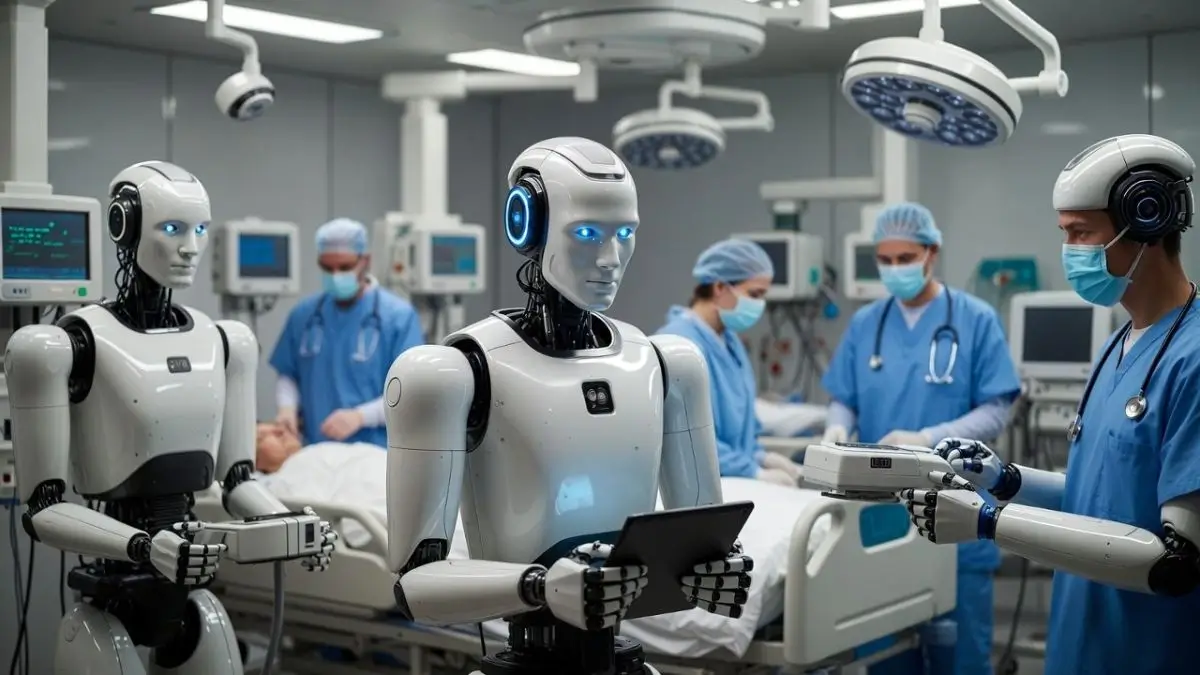
Integration of robots with AI and health care represents one of the major transformations in contemporary medicine and geriatric care. Smart robots represent autonomous or semi-autonomous devices endowed with AI and other sophisticated features. They have greatly transformed care services, management of chronic diseases, and assistance to elderly patients. Robotic technology finds application in numerous areas, starting with surgical robots that ensure precision of interventions and ending with companion robots that alleviate feelings of isolation and loneliness of their owners. In the current paper, I am going to examine contemporary developments related to the use of robotic technology in homes and hospitals. Special attention will be paid to successes and challenges in this area.
Robotics in Healthcare: Improving Clinical Quality
The medical robotics market is really taking off. Hospitals everywhere are spending a lot of money on surgical systems and diagnostic robots. The da Vinci Surgical System is still the way to do minimally invasive surgery. It helps surgeons do procedures with accuracy than ever before. This means patients have trauma, blood loss and recovery time.
Medical robotics are also used outside of the operating room. Robotic exoskeletons are helping people recover from injuries. They are really good for stroke victims and people with injuries. These robots help people regain mobility and neuroplasticity through therapy that is repeated times. This is something human therapists cannot do.
There are also robots that move through hospital hallways. These hospital logistics robots bring medications, samples and supplies. This means nurses can focus on taking care of patients. Medical robotics are also used in pharmacies. They help cut down on medication errors and speed up the dispensing process. This used to take up a lot of time for healthcare workers. Now robotic systems are making things run smoothly. The medical robotics market and medical robotics, in general are really making a difference.
Some diagnostic robots with AI algorithms are now able to find cancers, fractures, and other diseases in medical images as well as or better than human radiologists. Telepresence robots are helping specialist doctors reach hospitals and clinics in rural areas, making it easier for everyone to get expert advice. Ultrasonography robots are being used in places where there aren’t many trained sonographers, which makes Point-of-Care ultrasound possible on a large scale. These advances do not replace human expertise; instead, they enhance and expand clinical capabilities. The best implementations know that robots do best when they do tasks that are repetitive, require a lot of precision, or are physically demanding. This lets human doctors focus on diagnosis, making decisions, and the important human connection that is still at the heart of healing.
Changing Daily Living and Home Care
Robotics can be used in many places, not just hospitals. Most of the care that people get happens in their own homes. Eldercare is probably the most interesting use case because developed countries are going through huge demographic changes, with populations getting older and fewer people available to care for them. Robot arms mounted on beds and wheelchairs assist the elderly and disabled to carry out activities such as bathing, dressing, and grooming. It is an easy way of assisting such individuals that maintains their dignity while at the same time reducing injury and caregiver burnouts.
Mobile manipulators are capable of walking inside the home, picking objects, opening doors, and performing simple household activities that become difficult due to age-related changes or disability. The socially assistive robot acts as an interactive friend that assists in cognitive tasks by communicating with users, monitoring their vital statistics, reminding them to take medication, and calling for help from family members or emergency facilities in case of problems. Such robots are useful in handling individuals who suffer from dementia, anxiety, and autism spectrum disorder since they provide assistance regardless of the user’s state without making any judgment.
One of the other important applications is fall prevention and handling. The deployment of smart flooring sensors and robots will detect any fall and instantly contact someone to help before things get worse. The exoskeletons will assist those who have difficulty walking to stand up and walk around their home. This will boost their bone density, cardio fitness, mental health, and social interaction skills. Those who are highly immobile will have an easy time handling their surroundings using voice command robot technology which utilizes natural language processing. Robotic technology allows for emergency detection for people living alone without requiring a full-time caregiver. This enables policies where elderly individuals continue living independently while reducing the rate of institutionalization and associated costs.
Taking care of the global caregiver crisis
The most important reason to use robots in healthcare and home settings is probably the basic problem with people’s ability to care for others. The UN says that by 2050, the number of people over 80 will have tripled to 426 million worldwide. At the same time, fertility rates are going down in developed countries, which makes it impossible to provide traditional care models for older people: there won’t be enough people of working age to do it. Japan has the world’s oldest population and the lowest birth rate, so it has become a testing ground for robotic solutions to the problem of not having enough caregivers. Thai nursing homes are using companions now. This is something that is happening. Scandinavian countries are also using systems in the way they take care of people.
These robotic systems are not taking the place of workers like you might see in a scary movie. They are actually helping the workers. Robots are doing tasks that are repeated over and over. They are watching things. Human caregivers are doing things that’re much more important. They are building relationships, with people. Making big decisions. They are also giving people support. These are things that only humans can do. Robots cannot do these things. They should not try to. Thai nursing homes and Scandinavian countries are using robots to help with care. The care that humans give is very special. It is something that robots cannot replace.
Technological Progress and Present Abilities
In recent years, innovations in the realm of materials science, machine learning, and sensing technologies have unlocked a wide range of possibilities in the sphere of technological development. In particular, soft robotics based on the use of compliant materials, rather than rigid elements, enables robots to safely interact with people due to the reduction of mechanical dangers, which is crucial for the healthcare sector. Delicate human tissues may be manipulated by robots with the appropriate level of precision thanks to proprietary proprioceptive sensors and force feedback technologies. Contextual understanding, voice recognition, as well as contextual decision-making abilities are provided to robots through deep learning models trained on enormous datasets. Advances in battery technology enable robots to operate without recharging for a whole shift cycle. Furthermore, 5G wireless networks allow remote surgical procedures to be carried out in real-time, bringing advanced surgical services to underserved geographical regions. The technical basis behind all this technology continues to develop at an unprecedented rate, providing capabilities which were not even conceivable a decade ago.
Problems, restrictions, and moral issues
Despite the significant progress already achieved, robotics faces numerous barriers to becoming widely applicable in home and hospital environments. The foremost issue to consider is associated with the cost of technologies. Surgical robots cost over $2 million each, and the price of continuous maintenance and repair services is often very high; therefore, only those affluent healthcare organizations can afford such equipment. There are no regulatory standards developed yet for surgical and assistive robotics, which implies that some procedures performed by robots operate under legal uncertainty. Connected devices lacking cybersecurity and flawed safety-critical software represent a substantial threat to patients’ health and welfare. The public perception of robots varies from extremely positive to negative.
While some people welcome robots helping them around the house, others oppose the idea of replacing human care with technological advancements. Healthcare professionals are concerned with job losses, and for this reason, proactive strategies regarding the transition of the workforce should be developed proactively. There are considerable risks related to the collection and subsequent use of private data generated by patients using robots at home or during treatment procedures. Bias algorithms based on datasets that do not accurately represent the reality may further fuel healthcare disparity.
However, the question posed by philosophy about the possibility of replacing human relations with robot ones deserves reflection. Robots can be available all the time and assist their owners without judging them, but they cannot provide genuine emotional support and empathy that only humans can. It is possible that robots may be utilized in situations when human assistance should be provided to patients, but this will happen due to cost-saving reasons, rather than improving the health condition of the patient. Policymakers have to develop an ethical framework, which would allow robots to complement and not substitute human relationships in care provision, especially for vulnerable individuals. Further research is required to explore the consequences of human-robot interaction in terms of mental well-being and social behavior of children and patients with cognitive disabilities, as they may not be able to distinguish robots from humans.
The Way Forward: Integration, Not Replacement
Smart robots will not replace human caregivers in homes and hospitals. Instead, they will work together with humans to make the most of each other’s strengths. Robots are great at always being available, doing the same thing over and over again, keeping an eye on things all the time, and giving you insights based on data. People are good at being empathetic, creative, making moral decisions, and making real connections. The most successful implementations—at research hospitals, cutting-edge elder-care facilities, and creative home-care programs—clearly combine robotic abilities with strong human supervision and interaction. This complementary approach necessitates substantial investment in: workforce retraining initiatives that educate healthcare personnel on the management and interaction with robotic systems; regulatory frameworks that harmonize innovation with safety; standardized protocols for human-robot interaction in caregiving environments; and continuous research on clinical outcomes and patient satisfaction. Companies that use robots must be clear about their commitment to keeping people employed. Instead of replacing workers, they should change their roles to focus on more valuable tasks.
Conclusion: An Evolution That Must Happen
Robots that can think and act on their own are being used more and more in hospitals and at home. This is not something that might happen someday it is something that is happening now. In countries where people have a lot of money robots are being used to help take care of people because there are not caregivers and the population is getting older. The question is not whether or not we will use robots to help take care of people but how we will use them. We need to use robots in a way that’s fair and respectful to everyone.
The best way to use robots is to see them as helpers not as people who can take the place of caregivers. This way we can still have connection when we are taking care of people and we can use technology to help us take care of more people who need it. Robots that can think and act on their own also known as robotics can really improve the quality of life for people. Smart robotics can make it easier for caregivers to do their job give disabled people more freedom and help solve the problem of not having enough people to take care of others.
But for smart robotics to really work we need to have the rules in place we need to think about what is right and wrong and we need to plan for the people who will be working with the robots. The way we take care of people at home and in hospitals will not just be about using robots. It will not just be, about people. Smart robotics will be used to help people and people will be used to help robotics. It will be a mix of both.

Digital entrepreneur and content expert I help businesses with AI, SEO and the latest tech trends. I started Silicon Valley Weekly to make complex tech concepts easy to understand and use for business growth. I know a lot about systems and help startups, entrepreneurs and brands navigate the fast-changing world of tech and online marketing.
I build strategies that use data, search optimization, content marketing and AI tools to get visibility, engagement and revenue. I love finding ways for businesses to grow increasing their presence and turning new ideas into successful businesses. My goal is to connect the technology, with practical business use so brands can succeed online.