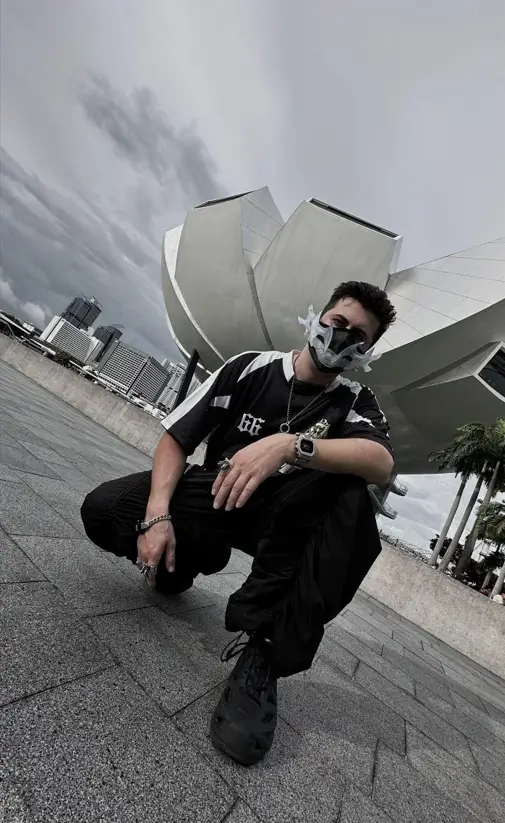
Nikita Replyanski is a cyber artist working at the intersection of art, technological design, and fashion. With a background in 3D game art and over a decade of experience in digital production, his practice has evolved into a multidisciplinary exploration of humanity through cyber aesthetics, AR, and 3D-printed wearable pieces.
Drawing inspiration from science fiction and cyberpunk culture, Replyanski has developed a distinctive visual language that merges physical and digital realities. In this conversation, he reflects on NFTs beyond speculation, the role of AI in redefining artistic authorship, and how emerging technologies may reshape identity, culture, and fan engagement in the years ahead.
1. You’ve collaborated with Anyma, Grimes, Adidas, Asics, Adobe, and Bring Me The Horizon – an unusually wide range from luxury electronic music to sportswear giants. What’s the through line that connects all these partnerships, and how has working at that intersection of culture and technology shaped your vision for where digital art is heading?
Over the past 12 years, my projects — from prosthetics and cybernetic fashion to NFT collectible art toys — have all explored the same core ideas: popularizing the values of post-humanism.
As an artist, I create a space for discussion around these ideas, showing both their advantages and their risks. Collaborations allow me to bring this conversation to a much wider audience — especially when working with major brands or global artists.
For example, when artists like Anyma or Grimes appear in my futuristic designs in front of millions of people, they present that technology itself can be a form of status. At the same time, this helps shift public perception toward people who wear robotic prosthetics not by choice.
I approach commercial collaborations the same way I approach my personal work: as an opportunity either to introduce new meaning or to create something genuinely surprising using innovative technologies — whether that’s AR, AI, blockchain, or 3D printing — that are actively reshaping culture and industry.
2. Most analysts write NFTs off as a dead chapter. Yet AI agents are beginning to use NFTs as tools for identity and data ownership. Make the case for a skeptic: why won’t NFTs just survive – why will they become core infrastructure of the agentic economy?
NFTs are truly a phenomenon within the art market. It’s hard to compare anything to the scale of trading, the level of hype, and the number of new artists and collectors. I still feel a deep sense of joy in being an active participant in this space.
This phenomenon was born at the intersection of art, digital ownership, blockchain innovation, 24/7 global online commerce, and social media as a direct communication channel between artists and collectors. Add to that a relatively low barrier to entry — and, of course, the potential for fast financial gains.
The hype has passed, but the underlying technology and ecosystem have not disappeared — they’ve continued to evolve. In fact, NFTs helped push entirely new forms of digital and tech-driven art into traditional art institutions, proving there is real demand.
One of the most striking recent examples is the new Zero10 section at Art Basel in Miami and Hong Kong, which now represents digital and phygital artists — many of whom emerged from the NFT space. It has demonstrated both strong audience engagement and solid sales results.
Today, the NFT art market increasingly resembles the contemporary art world: artists with strong conceptual value, collectors, and communities that are genuinely engaged with digital and phygital art.
I’m glad to see that technologies of digital authenticity are entering a new phase of relevance. To me, this is not a cycle of death and rebirth, but a natural evolution. Many artists in my circle continue to successfully sell their work, so I never saw the absence of hype as the death of the industry.
3. Artists who chased the NFT wave often ended up with collections nobody wanted. Now AI is everywhere. What’s the actual mechanism – not the hype – that lets an artist use AI to make NFTs meaningful again? Can you give a concrete example from your own work?
This question goes far beyond NFTs. If it is now possible to generate almost any image, sound, or content using AI, what is the role of the artist today?
Leaving aside the legal complexities around copyright and the use of training data, my position is the following: AI pushes artists into a direct confrontation with meaning. It demands a conscious approach to visual language and forces creators to reinvent themselves.
I focus on four key directions where AI enhances the value of my work:
Conceptual depth.
Behind every meaningful artwork are days of research, data gathering, and references to projects from previous generations. AI allows me to process and structure this information much faster, leaving more time for artistic realization.
A visual laboratory for digital and physical projects.
Up to 90% of a project’s success lies in pre-production — visual exploration, experimentation, working with forms, colors, and mistakes. AI tools provide a full-scale laboratory for this process, which I then refine into the final result.
Process optimization.
From reducing rendering time to creating custom sound, programming, and production workflows — AI enables capabilities that were previously inaccessible to a solo artist.
AI as a final medium.
Regardless of format, AI can become the primary medium of an artwork. But this is also the biggest challenge. It is essentially a collaboration with a powerful technology, and the audience can clearly see when the AI outweighs the artist.
If a work is purely aesthetic, lacks a distinct visual language, or simply follows trends without depth, it becomes obvious immediately. AI can expose the artist very quickly. If you remove the neural network and nothing meaningful remains, it is better not to pursue the project at all.
In short, AI allows artists to deepen meaning, scale research, accelerate execution, and explore new media — but only if they develop a strong and authentic voice.
4. You’ve been working on a new project — can you tell us about it? What problem does it address, and why now?
My exploration of AI as a medium led me to a project called are_you_human?, which I created together with Kirill Pobedin and our team.
For the past year and a half, we’ve been developing an artistic universe that explores present-day trends through the lens of humanity’s future. At its core is narrative — text, reflection, and a response to contemporary existential questions.
AI tools allow us to visualize ideas about a future where AGI is not an enemy, but an environment in which a new form of humanity exists. Concepts of a technological apocalypse often act as emotional substitutes, programming society toward survival without offering new perspectives. We are interested in exploring alternatives.
We ask questions such as: What new meaning will life have if immortality becomes possible? How might current trends reshape creativity and art? Where are the boundaries of ethics if physical form becomes a matter of choice? What happens to history if cinematic-level fakes are already possible? Will the “supernatural” still exist if future beings possess abilities once considered mythical? And ultimately — what defines humanity?
We treat this project as a fully developed artistic statement that can stand in dialogue with contemporary art institutions. The positive feedback we receive from experts confirms that we are moving in the right direction.
The NFT collection format is a way to distribute ideas and build a community around the project — bringing together tech enthusiasts, entrepreneurs, and investors who are actively shaping the future we are exploring. We engage with them through both offline and online meetings, exchanging perspectives and practical insights.
This universe extends beyond NFTs. We are currently working on a pilot series and physical artworks that continue this exploration.
5. Ahead of the upcoming World Cup hosted by the US and Mexico from June 11, FIFA has launched a native blockchain and official prediction markets. Do you see opportunities for NFT integration into these major sporting events? Are there any potential collaborations or concepts you are considering in that space?
Initiatives like this are generally a positive sign. Through such technological experiments, brands build communication with new audiences and position themselves within the Web3 space.
Real opportunities emerge when this communication is built consistently over time. One-off drops or short-term activations designed purely as additional revenue streams rarely last.
However, if FIFA takes a strategic, long-term approach to Web3, meaningful opportunities will follow. These could include collaborations with active collector communities, partnerships with relevant platforms that hold weight in the crypto space, and working with artists and creators who already have strong audience engagement and proven sales.
That is where sustainable value can be created.