Introduction
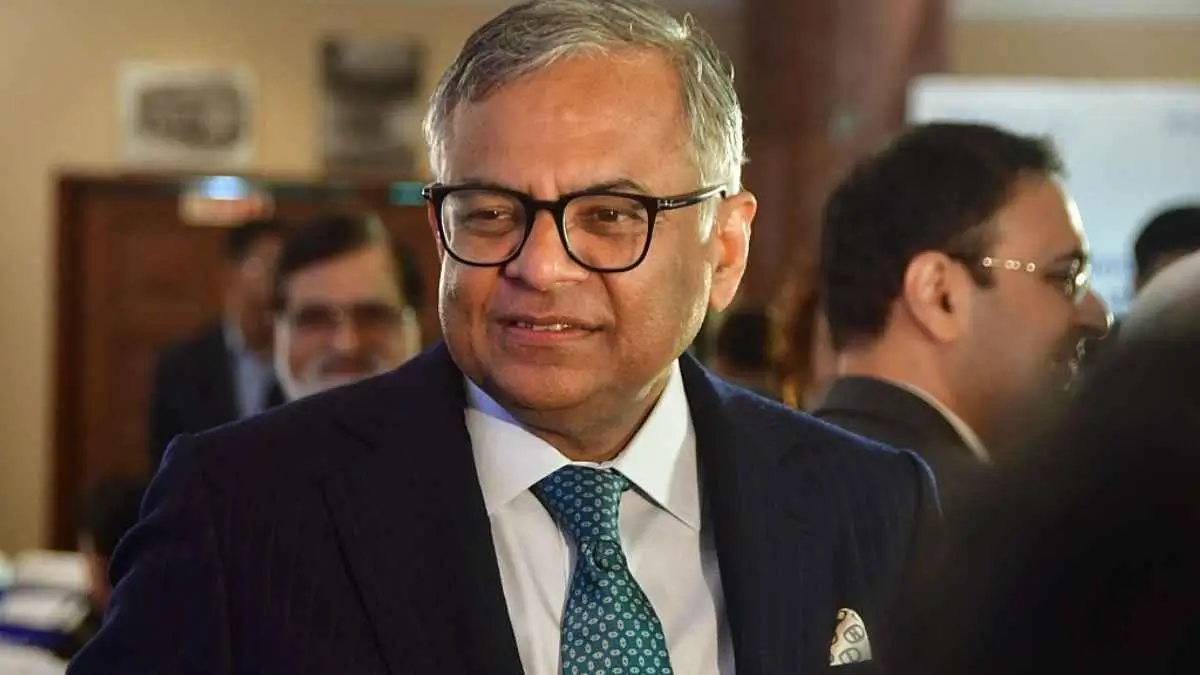
The story that describes Natarajan Chandrasekaran’s journey is the rare case in Indian modern business history where personal life events and professional success merge so deeply. He was born on June 2 1963 in Mohanur, a very humble village located in the Namakkal district of Tamil Nadu. From an early age, the farming family he came from was the source of their only income, and it was only through farming that education as a privilege was possible. Chandrasekaran’s father, who first was a lawyer but later went back to farming, planted the seed of frugality, long-term thinking, and hard work in young Chandrasekaran. As a child he and his younger brothers had to trek over three kilometers daily to go to a Tamil-medium government school – an anecdote that is now used to show an example of how far he has come – both physically and professionally.
The farming of the father of Chandrasekaran family became the family’s first hope for young Chandrasekaran’s future. But some inner voice drew Chandrasekaran in another direction toward where his talents might develop. After completing his bachelor’s degree in applied sciences from Coimbatore Institute of Technology, he took his master’s in computer applications from Regional Engineering College in Tiruchirappalli which is today known as National Institute of Technology, Trichy and finished his postgraduate studies in 1986. This achievement, a degree that came with a whole new world, not only gave a new identity to Chandrasekaran himself but also helped change the face of one of the most renowned corporate houses of India.
A Career Built One Rung at a Time: The TCS Years
It was the year 1987 when Natarajan Chandrasekaran entered Tata Consultancy Services as a youthful intern. He But was not related to the Tata family, had no executive sponsor or a direct line to top management. Instead, he depended upon his disciplined mind, willingness to work hard, and understanding of both the technology and the humans who use it. The way he rose in the company was neither dramatic nor rapid, rather gradual and as the outcome of his consistent performance and refusal of the backstab politics. He worked on the transformation of Indian software industry during its redefinition by the global outsourcing wave while still at relatively low position and proved his capabilities one by one.
By the time he became the chief operating officer and executive director, he was a very valuable asset of the company. In 2009, he was promoted to the posts of CEO and managing director taking the reign of the company that already at that time has become the crown jewel of the entire Tata Group. His leadership of the TCS company set forth the values that he would display in his stewardship of Tata Sons altogether: the adherence to operations, preference to the big scale, ability to quickly identify the technological developments and a tireless drive to put Indian enterprises into international markets. It was the year he succeeded as a CEO when TCS already made its revenue go above six billion dollars at the year basis while being among top ten global IT service providers. With him at the helm, TCS reached the ten-billion-dollar revenue threshold in 2012, expanded its capabilities in digital services, and cemented its role as the top company in India, both for value and employment in the private sector.
The period of Chandrasekaran at TCS was marked by his unwavering attention to the client, readiness to embrace technologies of tomorrow like cloud computing and digital services, and an expansion on the international plane resulting in a presence of TCS in such parts of the world as North America, Europe, and Asia. Based on him, he knows at least 5000 employees by name, this is an extraordinary piece of information not just about the capacity of his memory but also about his leadership vision which he sees and describes quite deeply as a human-centered activity.
A Historic Appointment: The First Non-Parsi at Tata’s Helm
The situation was unusual that resulted in Chandrasekaran getting the chairmanship of Tata Sons in 2017. After Cyrus Mistry was unceremoniously and bitterly removed from chairmanship of Tata Sons in October 2016, the group found itself very short of a leader who was able to stabilize the situation, inspire trust in the stakeholders, and at the same time carry on the legacy of the company while maintaining the future of the group without compromising. The group had only one thing in mind, finding a leader. A committee of five members formed for the selection came up with a clear recommendation, Natarajan Chandrasekaran, at that time the CEO of TCS, had to be the person for the job. In January 2017, he started as the executive chairman ofTata Sons, and on February 21, he took the formal leadership.
It was not only an unusual appointment using the background but many other respects of it as well. He was not only a professionally trained executive becoming the leader of the Tata Group but also the first non-Parsi to hold that position which was symbolic that a new era of the 156 years old foundation where the head positions had until then been drawn from within the founding family and its community was in the offing. His being chosen was a message about the worth of a person, the change in Indian corporate governance and the kind of leader that the modern Tata Group was to have.Being a first-generation leader, he came on board without the expectations related to dynastic tradition and had the freedom, and the obligation, to lead purely on the merit of his vision and achievement. His having been with the Tata family for nearly thirty years gave him the experience and understanding of an insider to the point that no other outsider could have matched those assets.
The “One Tata” Philosophy: Simplification, Scale, and Synergy
One of the reasons why Chandrasekaran is considered by many as a major contributor to the Tata Group besides running Tata Sons is In reality he has successfully laid the vision and rolled out what he calls “One Tata” strategy. As this concept, a large conglomerate can accumulate inefficiencies and overlap due to a large number of fragmented and isolated units. So the solution is to simplify, focus on scale, and maximize synergy by three principles. Rather than mere structural unity, the aim here would be strategic cooperation so that Tatas with many businesses will be working less as separate entities and more like an integrated network where common objectives and shared resources make each individual’s performance even better.
The implementation of this vision has enabled Chandrasekaran to consolidate business operations, raise the ownership stakes of company promoters, and promote a culture of innovation and technology throughout the group. The former Managing Director encouraged the group companies to make heavy investments in artificial intelligence, cloud computing, and data analysis, making clear his conviction that a technological overhaul cannot be left to others, it must be initiated with the front-line role. His style is quite similar to what he learned at the helm of Tata Consultancy Services – the philosophy of working with the system, the willingness to invest time in achieving the goal rather than getting short-term benefits. When he explained it in the first instance, using the advice of his father, it is quite clear that for decisions that have a long-term effect, one must think deeply whereas one-off decisions may be taken at a lighter level. Each of the large-scale strategic decisions of Tata Sons reflects precisely that mindset.
Taking to the Skies: The Air India Transformation
Chandrasekaran has made very bold moves during his time as boss. Only a very few of them have truly captured the Indian imagination, none probably more than the purchase of Air India by the Tata Group. The country’s flag carrier, which suffered from years of losses, inefficiency, and political interference, became a symbol of wasted opportunities – a proud airline whose performance had deteriorated to the point that it was no longer a match for its competitors. When the Indian government revealed its plans to privatize Air India, Tata Group was an aggressive bidder and So acquired the airline, This way reintroducing the group as owners of Air India to its original owners a long seven decades ago. The acquisition was finalised in the early 2022 and Chandrasekaran took it very personally – he became the head of the airline to show that the group would go all out for Air India’s revival. Turningaround of Air India under the new Tata brand has arguably been one of India’s major corporate turnarounds. With his focus on unifying Air India and AirAsia India under a common brand, he was the one who led the integration of Tata’s aviation assets.
Through a series of significant investments covering aircraft technology customer experience, and human resources, Chandrasekaran expressed a desire to make the airline an international one with enough size to compete against the world’s top airlines. The path has Yes not been easy – legacy debts, operational complexity, and inherent difficulty in changing a large workforce’s culture quickly – but the group has been heading in very positive direction. In Chandrasekaran’s eyes, Air India is more than just the restoration or rebuilding of India’s domestic carrier; it’s a springboard for getting Indian aviation into a bigger, global market.
Building India’s Industrial Future: Semiconductors and Electronics
Chandrasekaran, Yet, has shown courage to the extent of not only reaping a lot with his new Tata Group strategic initiative, but also, kind of, positioning the company as central to India’s upcoming industrial development. With his leadership, the firm has successfully done big investments into different fields where India has previously relied mostly on imports to meet those needs, namely semiconductors and advanced electronic devices. Tata Electronics is currently building a semiconductor fabricating plant in Dholera Gujarat backed by an approximate 91,000 crore INR investment, and is simultaneously setting up a chip packaging unit in Assam with a 27,000 crore INR investment. The Dholera plant will first target production of chips at 28-nanometres or larger, through partnerships with top technology companies, the ambition is to build an even broader and deeper semiconductor system that surrounds the plants.
Chandesarakan has clearly laid out what is at stake in this venture. Based on him, investments in semiconductors, precision manufacturing, electric vehicles, batteries and other connected sectors might lead to generation of 5 lakh manufacturing jobs in 5 years – this estimate places Tata Group right at the spot where it would take part in India’s dream to reduce dependence on imported supply chains and become a reliable and competitive manufacturing nation globally. Besides that, Tata Electronics has come up as one of the leading companies in India electronics production, serving as one of the group’s biggest ambitions to make its way into Apple’s supply chain network. These are just some risky and long-term business bets which full results would only become visible years later – and Chandrasekaran was always straightforward at the time – but the belief is what has kept his heart from turning to stone.
Driving the Electric Vehicle Revolution
No sector better showcases the scope of Chandrasekaran’s strategic creativity in a vivid way than electric vehicles. Under his leadership, Tata Motors has become the leading supplier of electric vehicles in India’s early EV market, at a peak point, having controlled more than ninety percent of the sale of domestic electric cars through the channel. Chandrasekaran has stated that the drive toward EVs serves not just the company’s revenue goals but also India’s carbon-cutting target wider, promising that Tata will surpass government’s thirty percent EVs passenger vehicles by the year 2030. He made arrangements for Tata, apart from locally building battery cells, also developing its semiconductor capabilities to support its push towards greener energy, these dreams show his tendency to control as much of the value chain as possible.
Not only has Chandrasekaran talked frequently of Tata’s global EV ambitions but beyond the Indian market, he has stated, that the company has such many expertise talents etc. from every relevant field that is absolutely rare or unique, and that is precisely what makes Tata capable of producing mobility solutions that are highly competitive. It was the standalone EV subsidiary of the company that unveiled the intention to introduce ten new electric vehicle products up to the year 2026, which will be backed by financial support for designing three unique vehicle models. In addition, the group is engaging in cooperation with world-renowned semiconductor and technology companies to speed up its EV development. Electric vehicle to Chandrasekaran is more than a product, it is a means of reframing the position of the Tata Group in the international industrial system.
Financial Stewardship: Growth at Scale
The fact that Chandrasekaran’s tenure has witnessed such significant growth with numbers proves the coherence of his strategic ideas and the discipline in the implementation process. The Tata Group’s overall business performance under his leadership has reached a new record high in various financial years. In total, the revenue of over 100 operating companies reached USD 150 billion on an annual basis. Tata Sons’ own net worth went from approximately Rs 43,000 crore in 2018 to roughly Rs 1 49 000 crore by 2025; this is an indication of the massive financial backing of the holding company. The business of the conglomerate went up to thrice the net profit and almost twice the profits in five years alongside spending roughly Rs 5.5 lakhs crore in ventures in high-stakes fields. These figures speak about Chandrasekaran’s ability to manage the balance of short-term performance requirements and the courage of long-term investment, which is the hallmark of the highest standards of corporate custodianship.
The salary that Chandrasekaran had personally been earning from Tata Sons mirrored the financial path of the company. In the FY26, Chandrasekaran’s total remuneration amounted to 1586.6 lakh rupees. This was the highest annual payout he had received during the period of his tenure at the company and, a large portion of it was performance-based incentive rather than salary at all. This structure is intentionally done and significant: it aligns the interests of the leader with those of the company as the leader’s gains are directly attached to the company’s results,
A Leader Recognized by the World
Chandrasekaran global reputation, is clearly evident in the awards he has received from governments and institutions throughout the continents of Asia, Europe, and Africa. For services about trade and industry, in 2022 the Government of India gave him the Padma Bhushan, one of the country’s highest civil honours. France, in 2023, followed suit by conferring on him the Lgion d’Honneur, acknowledging the extent of his international activity and his role in building India-Europe economic relations. Also, the UK awarded him the title “Knight Commander” in 2025 by the Most Excellent Order of the British Empire through an honorary conferral, a rare recognition Yes, for the significance of the growing investments by the Tata Group in Britain and his contribution to India-UK business relationships.
Not only do such honors speak about him, but Chandrasekaran also matters a lot on some the most influential bodies. He is a co-chair of the US-India CEO Forum, a member of the Board of Governors of the New York Academy of Sciences, elected international member of the United States National Academy of Engineering, a member of the MIT CEO Advisory Board, and a member of the Stanford Doerr School for Sustainability Advisory Council. His chairmanship at the Indian Institute of Management, Lucknow, and being president of the court of the Indian Institute of Science, Bengaluru demonstrate the depth of public and educational leadership he takes on. Through his affiliations with these bodies, he is viewed not simply as someone heading a bigIndian enterprise but more importantly, as a leader who is shaping ideas and debates on technological innovation, sustainability, and business management around the globe.
The Marathon Runner and the Management Philosophy
Natarajan Chandrasekaran is quite a character when it comes to handling all aspects of life and business. Once you find out he is a very keen long-distance runner with marathons in Mumbai Tokyo New York Boston Amsterdam, Berlin, and Chicago under his belt, the reason for his mindset becomes obvious. His personal best of a 5h52m that was set in the 2014 TCS New York City Marathon wasn’t achieved by rushing. On the contrary, he gradually pushed himself throughout the run, and never once he lost sight of when and where the finish line would be. Exactly the same mindset he applies to his company decisions, he explains. He was the one of the speakers on long-term commitment and it’s value was something his Dad had taught him and his Dad taught that short-term thinking and long-term thinking require different mindsets entirely.
He practices leadership with an easygoing manner, tenacity, and a clear strategy. Sometimes, what is the easiest to praise is the hardest to maintain over a lifetime of managing dozens of companies, facing unpredictable challenges from different parts of the world, managing stakeholder hopes and expectations, making billion-dollar bets in industries where the benefits of your effort might only be visible in decades to come. One more personal trait that is worth mentioning, Chandrasekaran can remember by at least five thousand of TCS staff – based on numerous TCS executives, Chandrasekaran can remember by his staff names – and this says almost everything about him and what kind of leader he chose to be. He also went on a number of the Holy Char Dham Yatra, which shows the depth of his spirituality and commitment to the inner renewal that complements his professional achievements.
A Defining Departure: The Legacy He Leaves Behind
On 12th August 2026, Natarajan Chandrasekaran informed Tata Sons’ board that he will not seek reappointment after his current term ends in February 2027. He urged the board to start the succession process quickly so that the group’s strategic projects – quite a few that are critical to their successful completion – will be appropriately managed after transition. His statement was very balanced and modest: “I have spent 40 years in the Tata Group and it is very special for me to be able to serve this wonderful company. It has been a great pleasure and a tremendous responsibility, I might dare say, to lead Tata Sons for this number of years.
” The news shook the Indian financial markets with several shares of Tata group companies dropping in the opening trade which paradoxically highlighted that he is one of the central figures that the investors trust for the company. His exit coincides with an intricate phase inside the group. There have been reports that one board member objected to Chandrasekaran ‘s continued appointment as a chairperson. This board disagreement has resulted in the stalled decision to appoint the person to another board under the Company’s governance arrangement. It is now being looked back at as one of those situations where the matter of merit, rules and dynamics of trust in large organizations have come at a crosspoint.
In no way should all these issues take away the credit that Chandrasekaran is due for the work he did. As he took over from his predecessor, the company was facing a difficult leadership crisis, but now, when he is leaving, the giant corporation has completely transformed itself from what was once a foundation: it is more strategically diversified, financially stronger, and clearly aligned with the industries that will have a huge role in the global economy in the coming decades.
A Legacy Written Across Decades
Natarajan Chandrasekaran’s story is first and foremost a tribute to the power of sustained work and a clear objective. From walking over 3 km (1.8 miles) to a Tamil-medium government school in Mohanur, he has now reached the level of a business icon as he chairs the councils of Tata Steel, Tata Motors, Air India, Tata Power, and more than a dozen of other companies. This has been a journey, to say the least, of an impossible scale for most. His climb to the top of Indian business was neither by birth nor due to connections, but it was the result of a blend of intellectual rigour, human warmth, strategic foresight and long-term thinking, which his father impressed upon him, even before setting foot on a corporate building.
His heritage goes beyond the companies he led or the areas he entered. It is the example of a boy from a farming family in rural Tamil Nadu getting only Indian education being able to lead the great world conglomerate, receiving the praise of national governments from three different continents, and making an institution stronger, better, and larger than he found it. This, in a true sense, is how we quantify a visionary leader. Natarajan Chandrasekaran in his entire career has proved that he is the embodiment of a great leader. He has deserved that title at every stage.

Digital entrepreneur and content expert I help businesses with AI, SEO and the latest tech trends. I started Silicon Valley Weekly to make complex tech concepts easy to understand and use for business growth. I know a lot about systems and help startups, entrepreneurs and brands navigate the fast-changing world of tech and online marketing.
I build strategies that use data, search optimization, content marketing and AI tools to get visibility, engagement and revenue. I love finding ways for businesses to grow increasing their presence and turning new ideas into successful businesses. My goal is to connect the technology, with practical business use so brands can succeed online.