
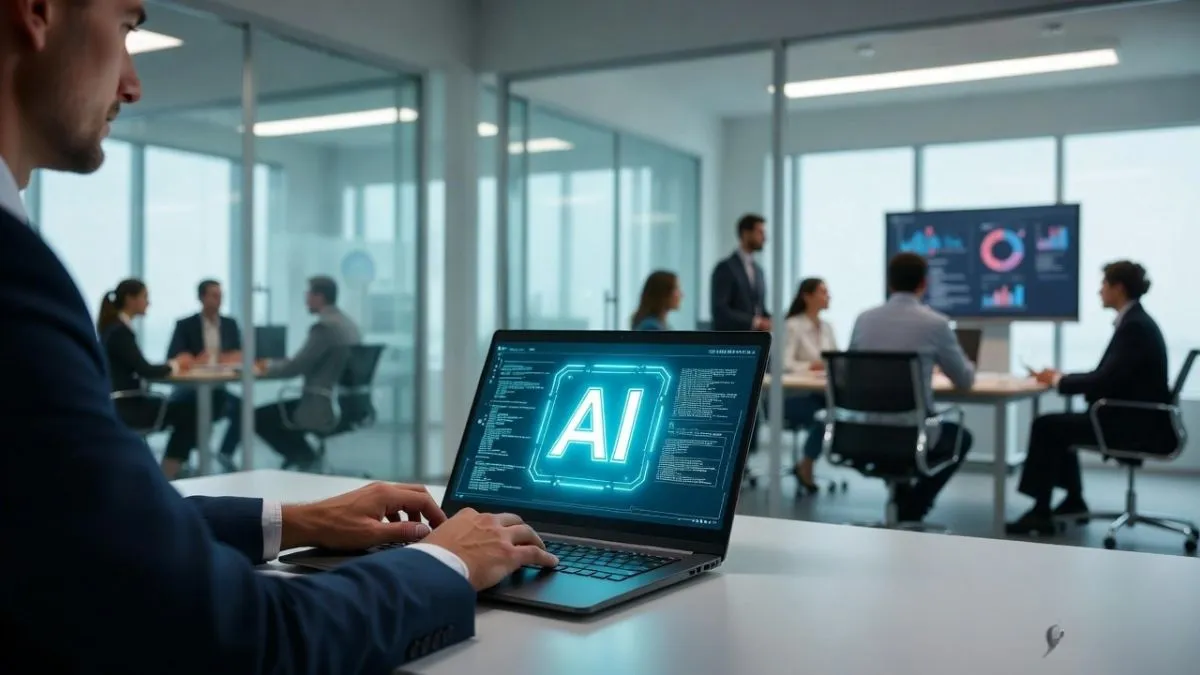
In the majority of the industrial era, opportunity was taken by those who recognized it first. The merchant with the best information, the manufacturer with the best process, and the store owner who has the greatest sense of what consumers wanted benefited because they were faster than their competitors.
Even though artificial intelligence still follows the same principle, it simply has made it faster and easier for everybody to take advantage of it.
From Hindsight to Foresight
Traditional business analytics looks backwards. You look at what has happened in the last quarter, using dashboards, and the analysts tell you why it has happened. But using AI puts your focus forward. This enables you to leverage machine learning models which can analyse millions of pieces of data, such as purchasing behaviour, supply chain information, social media sentiment and macroeconomic factors.
This helps you identify patterns in the data which no human team could do without the help of AI. This improves your forecasting but also means you are able to act before the market tells you. If your retailers know there is going to be an increase in demand then they can prepare their inventory. If lenders know the early signs of default then they can take steps to avoid this happening. They are actively identifying opportunities.
Personalization at Industrial Scale
Of all the changes brought about by the adoption of AI by companies, the biggest change comes from how they view their customers. Traditional mass marketing viewed customers as a generic bulk, but with AI, it becomes viable to personalise your approach to every single customer. Recommendation engines, dynamic pricing and chat bots all personalise a customers experience.
This has some clear business benefits. Personalisation increases conversion rates, improves loyalty and lowers customer acquisition costs. The real benefit though is that good listening skills, even if done using algorithms, will help build trust with your customers that can’t be easily mirrored by others.
Efficiency as a Strategic Weapon
Cost saving may be the least exciting area where AI can make a difference, however it can also be argued it is one of the most overlooked. By automating basic functions like invoice processing, customer queries, scheduling and quality checks, your employees can become free up to do more meaningful tasks.
A strategic benefit of this is that you can have fewer people on your team, but you’ll have more strategically used people. Analysis can take place by reducing the time spent cleansing data, support staff become more valuable by dealing with more complex cases. Your organisation will be improving their overall intelligence.
Recommended for You:
- Creator Economy and Micro-Business Models: The Future of Independent Businesses
- Vertical AI Copilots: Transforming Industry Expertise into Intelligent, Purpose-Built Solutions
- Business Debt Management: Building Financial Stability Through Strategic Borrowing and Smarter Repayment
Smaller business will benefit from this the most. These tools that would have cost an enterprise company can now be purchased at an affordable price. This means a 10 person start-up can have the same level of analysis as a multinational. Whilst it may not be completely level playing field, but there has definitely been some levelling.
New Products, New Markets
Artificial Intelligence does not only enhance the former models of businesses but assumes the creation of new businesses as well. Predictive maintenance helps transform the sellers of equipment into service providers.
Diagnostic algorithms make changes to the categories in healthcare. Generative tools change the process of content making, design, and software production reducing the time of coming up with an idea to creating an invention. Companies that see AI as a source of innovations instead of just a tool for improving the efficiency of business will become leaders in the market in the coming years.
The Caveats That Matter
There needs to be some level of control. AI systems are only as good as the data they are trained with. If the data is flawed then the resulting outcomes will be flawed, but given with misleading confidence. There can also be bias within the training data which can lead to unfair outcomes being cemented.
When using more advanced AI systems, there are also increasing concerns around privacy, regulation and security. In addition, there are real concerns within the workforce. If these are ignored then there can be resistance, employees leaving and failure to adopt.
To implement an AI system correctly it needs to be well governed. Know who is responsible for it, make sure if possible that the model is transparent, ensure that important decisions are made by humans and invest in upskilling. Using technology without doing this will actually become a disadvantage.
The Verdict
AI is not magic or a threat, but a tool that can magnify our understanding, improve processes, and make mistakes if not used correctly. Businesses will succeed by combining algorithms with human intelligence. This means using machines to gain more visibility and humans to make intelligent decisions.
As a leader you are no longer asking yourself if AI will change your industry, but whether you will proactively manage how it changes your industry. With an economy becoming increasingly competitive, intelligence will be gained by those who start first.

Digital entrepreneur and content expert I help businesses with AI, SEO and the latest tech trends. I started Silicon Valley Weekly to make complex tech concepts easy to understand and use for business growth. I know a lot about systems and help startups, entrepreneurs and brands navigate the fast-changing world of tech and online marketing.
I build strategies that use data, search optimization, content marketing and AI tools to get visibility, engagement and revenue. I love finding ways for businesses to grow increasing their presence and turning new ideas into successful businesses. My goal is to connect the technology, with practical business use so brands can succeed online.