The Future of AI in 2026 marks a major change from hype about experiments to real-world use and measurable effects. As of mid-2026, AI has gone from being a flashy showpiece to being a real partner in work, creativity, research, and everyday life. AI systems are no longer just tools for making text or pictures. They are becoming agents that can plan, act, and adapt on their own. This change brings both new chances and difficult problems that will change businesses, economies, and societies.
The Change from Hype to Partnership
In the past, AI development focused on making big language models and generative abilities work better. By 2026, the focus has shifted to efficiency, using AI in the real world, and working together with people. Experts say that AI will work more like a “partner” than a tool, improving teamwork, security, and research while making infrastructure more efficient.
Businesses are moving away from running pilots in one area and toward strategies that work for the whole company. More than 70% of big companies are using top-down AI programs that focus on return on investment (ROI), productivity gains, and integrating the workforce instead of just trying things out. This “disciplined march to value” puts measurable results, like how much money you make or lose and how your operations are different from others, at the top of the list.
Along with huge frontier models, smaller, more efficient models, which are often called small language models (SLMs), are becoming more popular. These hardware-aware systems speed up and make many business tasks more sustainable. They could cut infrastructure costs by up to 50% and make them available to more people. Some analysts are still talking about a “AI bubble,” warning that the economy could change if the hype outpaces the value delivered. However, all-in adopters who build “AI factories” (dedicated infrastructure) are likely to get ahead.
Agentic AI: From Helpers to Independent Actors
One of the biggest changes in 2026 is the rise of agentic AI, which are systems that can watch, plan, reason, and carry out complex tasks with little help from people. Multi-agent systems, where different AIs work together, are changing how work gets done in many fields.
Agentic workflows are increasing productivity at all levels of a business, from coding and data analysis to customer service and operations. But full autonomy is still hard to find in high-stakes areas. Value is growing in specific fields like programming, but more general measures of productivity are still developing. “AI economic dashboards” that show the effects of tasks on a high frequency are starting to show where AI adds to or replaces jobs.
New architectures that go beyond traditional transformers, like state space models, joint embedding predictive architectures, and world models, are making it easier to simulate reality and learn all the time. These improvements suggest that neural networks are more neuroplastic, which means that systems can change in dynamic environments instead of staying the same after training.
AI in Important Fields: Healthcare, Work, and More
Healthcare is one of the main areas that benefits. AI agents are making it easier to diagnose diseases, find new drugs, and make treatments more personalized. AI-powered virtual cells and single-cell atlases simulate biological processes on a large scale, speeding up the time it takes to develop new drugs. Medical devices with built-in AI can learn from patient data all the time, which makes them more accurate in areas like finding cancer and managing long-term illnesses. By 2026, AI will be at the center of patient experiences, and people will expect faster, more targeted changes.
AI is taking over boring tasks at work and making people more creative and better at making decisions. “Vibe coding” and AI-assisted development are changing the way software engineering works. But worries about skill loss are making companies offer “AI-free” tests to keep critical thinking skills sharp. Job loss is becoming more common, especially in support roles, as agentic systems take care of all the steps in a process. At the same time, new jobs are opening up in AI oversight, data foundations, and ethical governance.
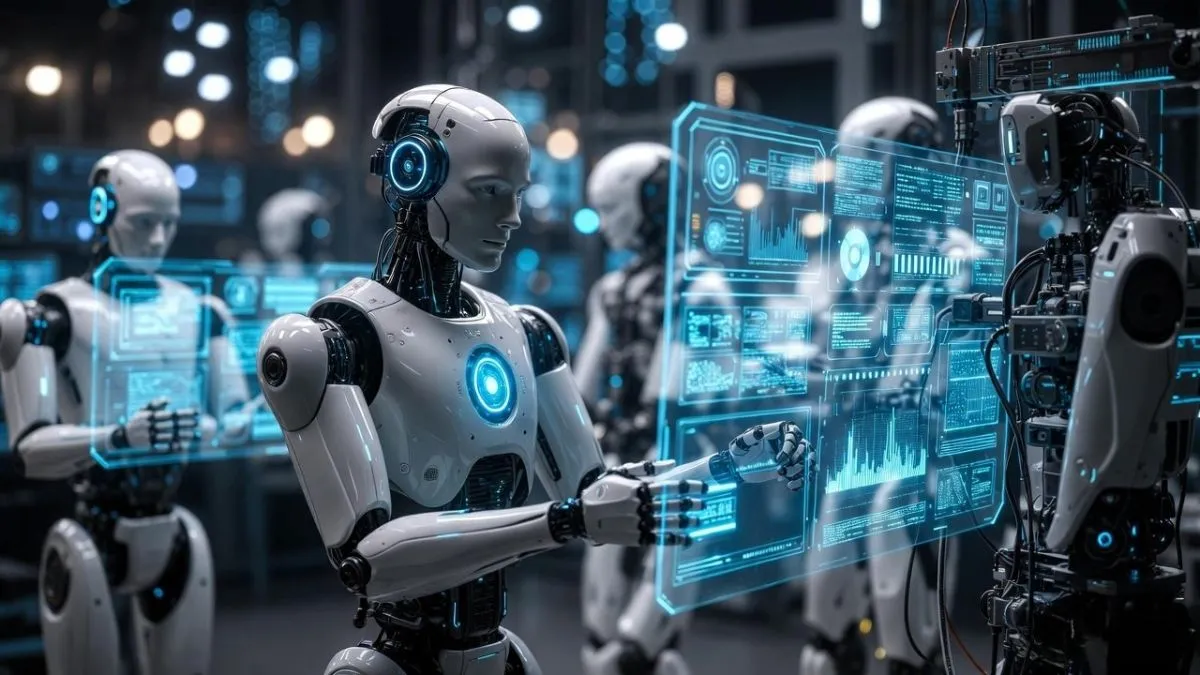
Robotics and autonomous systems are making physical AI better. AI-robotics hybrids are being used twice as much in manufacturing and logistics, which is boosting productivity. In transportation, work on fully self-driving cars continues. AI is getting better at perception, decision-making, and navigation.
The fields of education and the arts are also changing. Hyper-personalization at scale changes learning and customer experiences in real time. Generative AI is moving from tools that help individuals be more productive to tools that help organizations. “Citizen innovators” are using easy-to-use interfaces to solve problems without needing to know a lot about technology.
The Compute Challenge, Infrastructure, and Efficiency
The scaling laws that helped AI grow in the past are now reaching their limits. The industry is moving toward efficiency by using smarter hardware, better models, and more environmentally friendly infrastructure. There are hopes for big steps forward in quantum computing. Some people say that by 2026, quantum systems could do some tasks better than classical ones, but general quantum advantage that can handle errors is still a long way off.
Big companies are putting a lot of money into supercomputing clusters. For example, xAI keeps working on projects like the Colossus supercomputer, which is moving toward advanced reasoning, multimodal capabilities, and agentic systems in line with its goal of understanding the universe. Integration across ecosystems, like possible links to robotics and larger platforms, shows how compute, data, and algorithms are coming together.
The quality of the data and the “AI-ready” foundations have become major roadblocks. Companies are focusing on clean, governed data pipelines to make sure that agentic deployments work as they should. For AI agents, being able to see what’s going on is becoming important for trust and debugging.
Risks, Governance, and Effects on Society
More ability means more responsibility. As countries try to break free from dominant providers, AI sovereignty is growing. They are making platforms for specific regions with their own data. Rules about safety, bias, and ethics are getting stricter, and in regulated industries, governance is becoming a way to set yourself apart from the competition.
Some of the risks are that people will become too dependent on technology, that agentic systems will have security holes, and that decision automation could fail catastrophically, which has led to talks of legal claims and guardrails. Discussions about productivity are still going on. Some industries say they are seeing improvements, while others are unsure if the economy as a whole has improved yet. To lessen the bad effects, it is still important to have ethical AI policies, be open about them, and have people in charge.
AI is connected to national strategies in many ways, such as competition for talent and races to build infrastructure. The technology can be used for both good and bad things, so countries need to work together to find a balance.
A Balanced View of the Future in 2026 and Beyond
In 2026, AI is not a perfect savior or a threat to existence; it is a powerful tool that makes people better at what they do. Progress is not uniform; advancements in specific areas exist alongside ongoing difficulties in generalization, reliability, and equitable access. The best results will come from companies and societies that invest in responsible integration, which means combining technology with human judgment, strong data practices, and moral guidelines.
The year shows that the field is growing up: less flash and more substance. As AI becomes more common in workflows, infrastructure, and decision-making, its real value lies in boosting creativity, speeding up discovery, and solving tough global issues like access to healthcare and sustainability.
Looking ahead, more architectural innovation, better efficiency, and the ability to coordinate multiple agents all point to even more integration by the end of the 2020s. In 2026, AI will be a practical and hopeful tool for expanding what people can do while carefully considering its effects.
Frequently Asked Questions (FAQs)
What do you think will be the biggest AI trend in 2026?
Agentic AI and multi-agent systems are two of the most important trends right now. They let computers plan and carry out complicated tasks on their own. Models that focus on efficiency and integration across the whole business are also important because they help AI move from pilot projects to creating value on a large scale.
Will AI take jobs away in 2026?
AI will take over some routine and support jobs, which will lead to some people losing their jobs, especially when agentic systems handle end-to-end workflows. But it’s also opening up new possibilities in AI governance, data management, and creative and technical fields that are getting better. The end result depends on how well people learn new skills and adapt.
How is AI changing health care in 2026?
AI agents are speeding up the process of finding new drugs, making treatments more tailored to each person, and improving diagnostics through simulation and devices that learn all the time. Adoption is moving from testing to real-world use, which improves efficiency and patient outcomes but raises questions about oversight and how it fits with clinical judgment.
Could the AI bubble pop in 2026?
If investments lead to more productivity gains than are delivered, some analysts think the economy will have to change. However, companies that build “AI factories” just for that purpose and focus on measurable ROI are more likely to do well during any correction.
What will smaller AI models be able to do that bigger ones can’t?
Small language models (SLMs) and their more efficient versions are likely to handle most business tasks because they are cheaper, faster, and more sustainable. Frontier models will keep making research and complex reasoning better.
How important is it to have rules for AI?
Governance is becoming a competitive advantage and a legal requirement. As agentic systems become more independent, problems like bias, safety, data privacy, and skill atrophy are pushing for frameworks for transparency, observability, and ethical deployment.
Will we have AGI in 2026?
Most experts say that there won’t be any full artificial general intelligence by 2026. Researchers are still working toward systems that are more capable and focused on reasoning, but true human-level generality across all areas is still a long-term goal for many of them.

Digital entrepreneur and content expert I help businesses with AI, SEO and the latest tech trends. I started Silicon Valley Weekly to make complex tech concepts easy to understand and use for business growth. I know a lot about systems and help startups, entrepreneurs and brands navigate the fast-changing world of tech and online marketing.
I build strategies that use data, search optimization, content marketing and AI tools to get visibility, engagement and revenue. I love finding ways for businesses to grow increasing their presence and turning new ideas into successful businesses. My goal is to connect the technology, with practical business use so brands can succeed online.