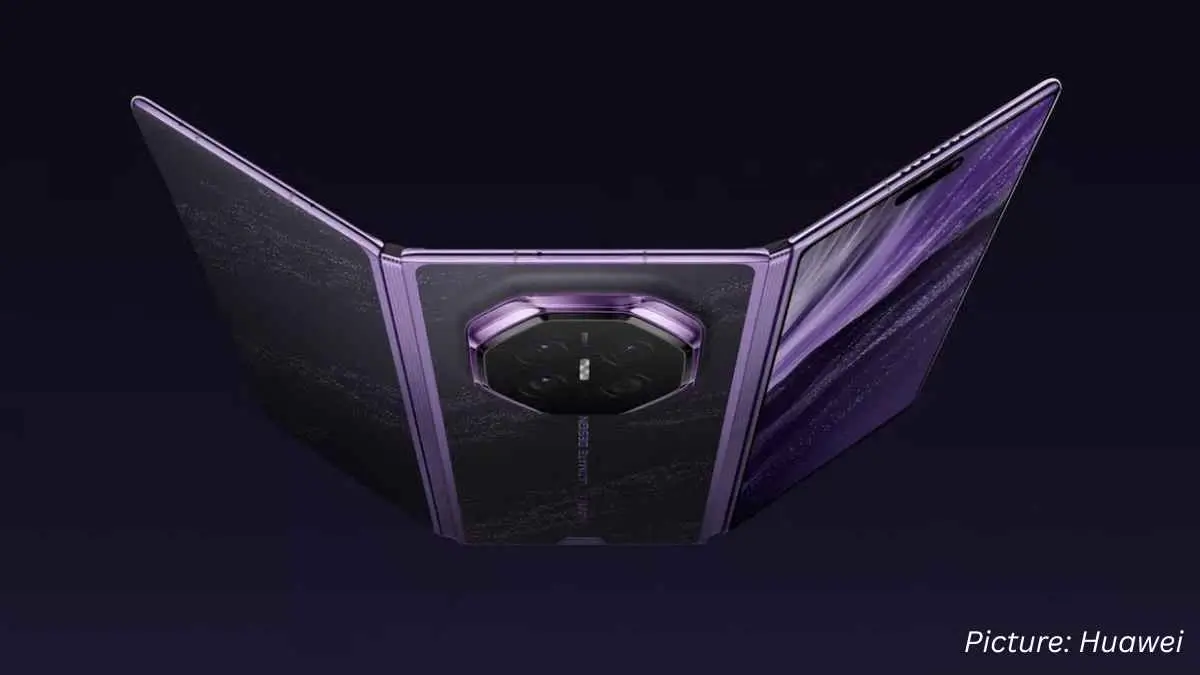
The Huawei Mate XT, unveiled in 2024, made waves worldwide as the first commercial tri-fold smartphone on the market. It looked fantastic, worked for real, and was priced like a piece of art. One issue, however, was impossible to ignore — the phone’s flexible display was exposed when folded closed, a design choice that made long-term durability a real concern.
To this end, Huawei has launched the Mate XT 2, which was officially released in China on September 7, 2026, together with HarmonyOS 7. It iterates not just on its predecessor. It reconstructs the entire folding philosophy from the first principles.
A new folding system
The biggest change to the Mate XT 2 is the one you don’t see when opening the phone up. Huawei has abandoned the Z-folding design of the original and replaced it with what it calls a wing-style tri-fold architecture. The two outer panels fold over the center section, enclosing the large flexible display within the chassis and protecting it when the phone is closed.
This is the same kind of protection Samsung has employed on its bi-fold Galaxy Z Fold series from the get-go, and it makes a lot more sense for a device this expensive. A naked flexible OLED panel on a phone that costs more than $2,800 was always going to be a hard argument to defend, and Huawei has done well to put that discussion to sleep.
A dedicated external display makes all the difference
To compensate for the inner display now being out of sight when folded, Huawei has added a dedicated 6.5-inch outer screen. This is one of the most useful upgrades the XT 2 has to offer. On the original Huawei Mate XT 2, users had to rely on some part of the flexible panel to perform their daily tasks.
The XT 2 has a traditional external display with a pill-shaped cutout for the front cameras that handles all the basic smartphone functions — messaging, calls, navigation, payments, notifications — without ever having to deploy the large inner display. If more real estate is needed, you can unfold the device and you get a 10.2-inch LTPO OLED display with 3K resolution. Now the choice between phone mode and tablet mode is a real choice and not a compromise forced by the hardware design.
Display Quality and Durability
The inner display is 10.2 inches and has a resolution of 2232 x 3184 pixels with a 90Hz refresh rate. Huawei has also developed UFG Ultra Flexible Glass technology, which the company says enhances fold resistance by 25 percent compared to the previous generation. The outer display is made of Kunlun glass, which Huawei says offers up to 30 times greater drop resistance, while the inner screen’s impact resistance has been improved by 200 percent and the hinge by 90 percent compared with Huawei’s internal reference designs.
These are manufacturer numbers, and should be taken as such, but the message behind them is clear: Huawei has built durability into its structure, not tacked it on as an afterthought. The phone is also rated for dust and water resistance at IP58 and IP59 – which is a big deal for a device with two hinges and a multi-panel flexible display.
Kirin 9050 Pro: Brand New Flagship Chip
The Mate XT 2 is the first device to feature Huawei’s new Kirin 9050 Pro processor, which the company claims is its most powerful chip yet. With Logic Folding 3D stacking, it achieves a 53.5 percent increase in transistor density compared to the previous generation. Huawei claims a 42 percent overall performance uplift over the Mate XTs, but that figure includes hardware, software, cloud, and system level improvements, not just raw silicon performance.
Independent benchmarks will tell the fuller story, but the practical point is: Huawei is pairing the enormous 10.2-inch display — the kind of screen that invites split-screen multitasking, document editing, media consumption and heavier workflows — with a legitimate flagship processor rather than a recycled platform. All variants of the phone come with 16GB of RAM, which is good enough for the kind of things the screen size naturally lends itself to.
Camera System 2
Foldable phones so far have had to compromise on the camera to keep thickness and weight down. Huawei hasn’t gone down that route with the Mate XT 2. The rear camera system includes a 50MP RYYB main sensor that is 1/1.28 inches in size with a continuous variable aperture of f/1.49 to f/4.0, giving the lens real control of depth of field and light intake. Beside it sits a 40MP ultrawide camera and a 50MP periscope telephoto lens that takes care of long-range capture without the optical compromises of a traditional telephoto design.
All three are promising, powered by Huawei’s third-generation Red Maple color sensor, which the company says offers a 95 percent boost in color reproduction over the Mate XTs thanks to better infrared-light filtering. On the front of the outer display’s pill-shaped cutout is a dual 8MP camera for video calls and selfies. The specs alone suggest Huawei is treating photography as a flagship priority, not an afterthought, until we see independent camera testing.
The Innovation of the Privacy Screen
One of the more interesting additions Huawei has made to the XT 2 is the Lingdun privacy screen, which is available on some of the storage variants. The display has an independent dual pixel design, and when privacy mode is enabled, the display reduces side-angle visibility so people nearby can’t see what’s on the screen.
This isn’t a gimmick on a device with a 10.2-inch display that will often be used in public settings — airplanes, train carriages, open-plan offices. It is a useful feature for professionals who deal with sensitive documents, financial data or confidential communications. Display still maintains full resolution when privacy mode is enabled, Huawei says, and you can toggle the feature on and off from the outer screen.
Battery, Storage, and Price
The Mate XT 2 has a 5,600mAh battery built into its three-panel chassis and supports 66W wired fast charging and wireless charging. Storage options include 256GB, 512GB, or 1TB, or 2TB in the premium stylus bundle — a remarkable high-end capacity that reflects the device’s role as a mobile workstation, not just a showpiece.
Available in four colors: Mysterious Black, Auspicious Red, Deep Purple and Bright White. In China, pricing starts at 19,999 CNY (approximately $2,800) for the 16GB/256GB model, rising to 24,999 CNY for the 1TB privacy-screen model and 29,999 CNY for the 2TB stylus model. The phone is still not widely accessible internationally because ongoing US sanctions prevent Huawei from offering Google services, meaning it’s basically off the table for most buyers in the West.
Conclusion
The Huawei Mate XT 2 is the most technically advanced tri-fold phone ever made. It folds inward to solve the biggest structural problem of the original, it adds a useful outer display, it pushes durability standards beyond anything multi-panel devices have ever seen, and it marries all of that with a flagship camera and processor.
It’s not light, it’s not cheap and in many markets it’s just not available. That said, for buyers in HarmonyOS-enabled regions who can justify the price — frequent travelers, mobile creatives, and productivity-first professionals who want a device that truly replaces both a phone and a tablet — the Mate XT 2 is the best case Huawei has made yet for the tri-fold form factor.

Digital entrepreneur and content expert I help businesses with AI, SEO and the latest tech trends. I started Silicon Valley Weekly to make complex tech concepts easy to understand and use for business growth. I know a lot about systems and help startups, entrepreneurs and brands navigate the fast-changing world of tech and online marketing.
I build strategies that use data, search optimization, content marketing and AI tools to get visibility, engagement and revenue. I love finding ways for businesses to grow increasing their presence and turning new ideas into successful businesses. My goal is to connect the technology, with practical business use so brands can succeed online.