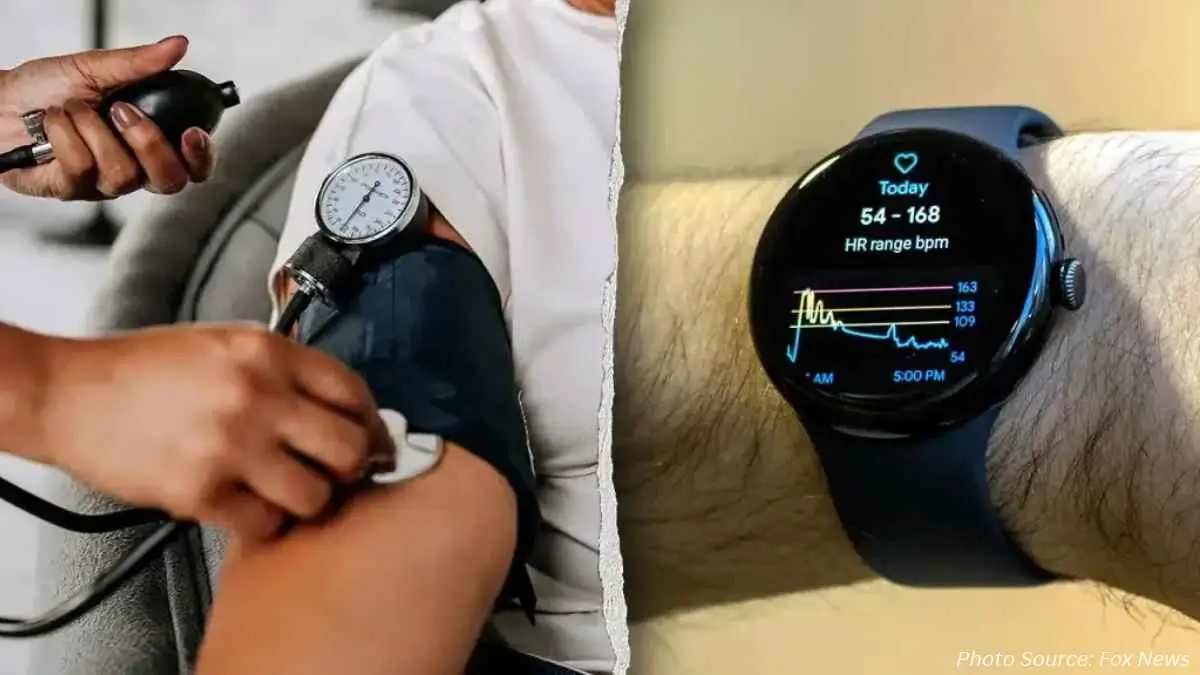
Scientists at Google are investigating how artificial intelligence and existing smartwatch sensors can be used to screen for high blood pressure.
Unlike standard blood pressure devices, this novel technology does not display readings for systolic and diastolic blood pressure. Rather, it uses smartwatch data to assess an individual’s chance of having chronic high blood pressure.
Whilst this has the potential to help to screen for high blood pressure, further research is required to fully test and assess the accuracy of the technology.
Google’s AI Screening For High Blood Pressure
The novel technology works by assessing data from two widely available smartwatch sensors.
One detects fluctuations in the amount of blood present just below the skin and the other measures body motion and subtle ‘shaking’ as the heart pushes blood around the body.
Google has then developed an AI algorithm which analyses smartwatch sensor data and an individual’s height to assess their chance of having chronic high blood pressure.
Scientists worked alongside researchers from Beth Israel Deaconess Medical Center and Harvard Medical School.
Nearly 500,000 hours of smartwatch data was analysed from 2,109 volunteers. Scientists then assessed the technology with a further clinical study, comprising 196 individuals at five sites in the USA.
Throughout the seven day study, participants wore smartwatches. Results generated by Google’s AI were then analysed alongside 24 hour ambulatory blood pressure monitoring. This is a recognised clinical technique which continually records an individual’s blood pressure both during the day and whilst they are asleep.
No participants had pre-existing cardiovascular disease or were on blood pressure medication.
Valuable Information – And Key Constraints Identified
Whilst the research provided encouraging information, there were also key constraints found in relation to the technology’s ability to screen for high blood pressure.
Around a third of those with high blood pressure were not successfully picked up by Google’s AI during the early stages of screening. Typically, medical centres are able to successfully detect 55.3% of people with high blood pressure in this early screening stage.
As explained in a summary of the research in Nature Portfolio, there was no statistically significant difference between the smartwatch and medical centre screening methods.
Scientists also tested the technology with a further cohort of 48 people. This group had had high blood pressure readings at their first medical appointment. Within this study, Google’s AI successfully identified 78.4% of these people as having chronic high blood pressure and accurately determined that 90.9% did not have the condition.
Although this research suggests that smartwatch health screening could be beneficial, wider research is necessary to fully assess how effective this novel technology is for different groups of people.
Furthermore, it does not yet show whether smartwatch screening contributes to enhanced detection of high blood pressure and/or improved long-term health outcomes.
Blood Pressure Trend Monitoring Already Available On Google Pixel Watches
Google has already launched features enabling individuals to analyse blood pressure trends. These were revealed in September 2026.
They are accessible via the Google Health app, free of charge, on suitable Google Pixel Watch 3, 4 and 5 watches (depending on location).
Google’s technology analyses data relating to heart rate and body movement. It then analyses this to produce a monthly report stating whether a person’s blood pressure trends appear to be high.
This shows a result of either ‘High’ or ‘Not high’. However, Google stresses that this feature is designed purely for general health purposes and is not for medical diagnostic purposes.
Whilst it does not give a person’s real systolic and diastolic blood pressure reading, a ‘Not high’ result also does not necessarily mean that an individual’s blood pressure is normal.
The company therefore advises against basing medical or treatment decisions on the figures provided.
Also important to note is that the novel Google AI screening technology is distinct from the current Google Pixel Watch blood pressure trend function. Google has made no announcements that it intends for this technology to be sold as a medical diagnostic tool.
Similarly, Apple Watches Provide High Blood Pressure Alerts
Alongside Google, Apple are also investigating how smartwatches can be used for health screening and in particular for high blood pressure.
Apple’s watches (Series 9 and newer and Ultra 2 and newer) can alert individuals if they are thought to have high blood pressure. This functionality is cleared for sale by the FDA and is available in software and locationally dependent ways.
It works by analysing data gathered from the watch’s photoplethysmograph heart sensor over around 30 days to recognise markers of chronic high blood pressure.
Nevertheless, Apple similarly stresses that its alerts are not for medical diagnostic purposes and that not all instances of high blood pressure may be successfully detected.
Those who are alerted are advised to then manually check their blood pressure using a conventional blood pressure cuff. They should then consult a medical professional to analyse the findings.
The Importance Of Detecting High Blood Pressure Early
Globally, over one billion adults are thought to suffer from high blood pressure. Alarmingly, many of these people are not even aware that they have the condition.
If left untreated, high blood pressure can progressively harm blood vessels and raise an individual’s risk of experiencing severe cardiovascular issues such as heart attacks and strokes.
People within younger age groups can in particular be at risk of not being diagnosed for high blood pressure as the condition is often not accompanied by overt symptoms.
Wearable technology may therefore form a valuable supplementary resource for detecting people who may not routinely attend for medical assessment. Yet still, further research is essential to assess the value of this technology for health screening.
Action To Take If Your Smartwatch Indicates High Blood Pressure Trends
An individual should verify a smartwatch’s suggestion of high blood pressure using a clinically validated automated blood pressure machine. Again, this should not be regarded as a medical diagnosis.
The American Heart Association suggests that automated upper arm blood pressure machines are most suitable for domestic use as they typically offer more accurate readings than those obtained from wrist or finger devices.
Google additionally suggests that a person should manually check their blood pressure twice each day for a period of seven days if they have received a ‘High’ result from the company’s blood pressure trend function. Individuals should then share these results with a medical professional.
It is key that smartwatch users adhere to guidance given by their blood pressure machine and ensure that they are using the appropriate sized cuff.
If someone experiences chest pain or breathing difficulties, they should urgently consult a medical professional.
Whist it is good practice to regularly assess blood pressure, even if a smartwatch never issues a high blood pressure alert, this is especially important.
The Future Of AI Health Screening
Google’s novel research has shown how artificial intelligence can augment wearable technology.
Ultimately, smartwatches may utilise photoplethysmograph, motion and machine learning technologies to recognise health concerns which cannot currently be directly assessed by typical consumer wearables.
Despite this, further clinical research is still required and smartwatch data must not be permitted to supplant recognised medical assessment techniques.
On a wider scale, wearable technologies can be utilised effectively to promote greater health awareness and to support ongoing health assessments. This may then prompt people to consult medical professionals at an earlier stage and so avoid the more severe consequences that can result from high blood pressure.
Reported by Fox News.

Digital entrepreneur and content expert I help businesses with AI, SEO and the latest tech trends. I started Silicon Valley Weekly to make complex tech concepts easy to understand and use for business growth. I know a lot about systems and help startups, entrepreneurs and brands navigate the fast-changing world of tech and online marketing.
I build strategies that use data, search optimization, content marketing and AI tools to get visibility, engagement and revenue. I love finding ways for businesses to grow increasing their presence and turning new ideas into successful businesses. My goal is to connect the technology, with practical business use so brands can succeed online.