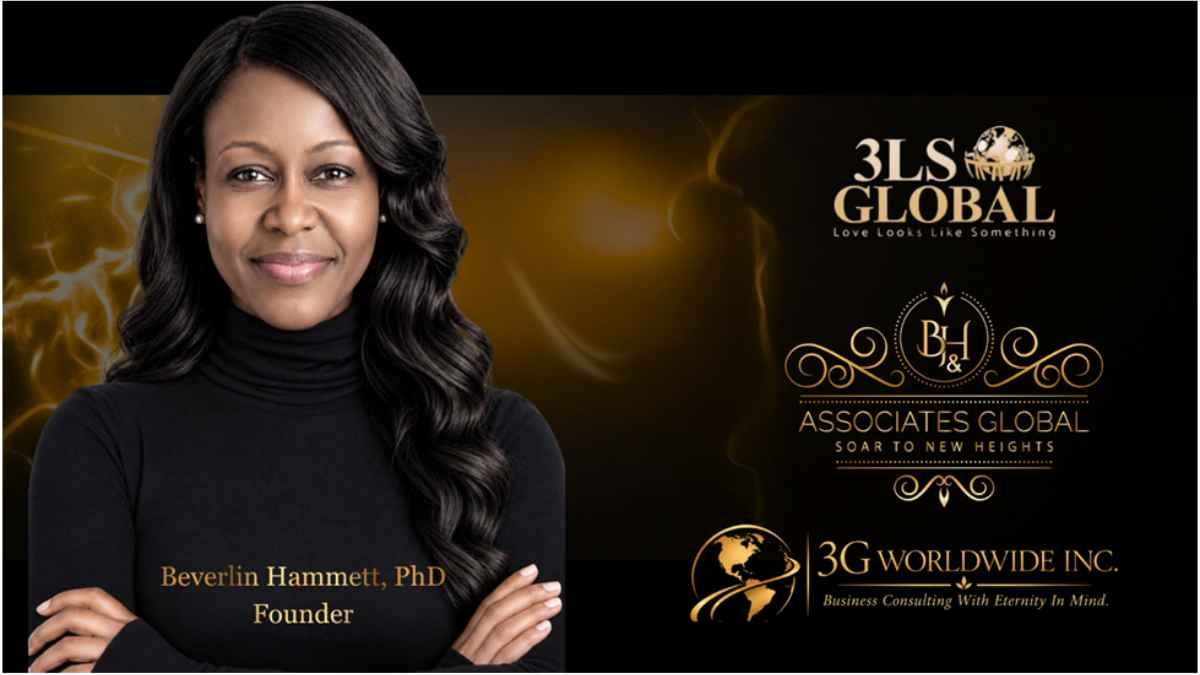
From the Bronx to Berlin, from Wall Street to Warsaw, Dr. Hammett has gathered more than career milestones. She has built friendships, taught future leaders, and served communities across 55+ countries. In this candid conversation, she shares the stories behind more than 40 years of work, the mentors she still calls, the students who still call her, and the faith that holds it all together. There is wisdom here, a little laughter, and a reminder that how we treat people matters long after the work is done.
Interviewer: Before we get into your broader leadership philosophy and let’s say style, I want to ask about your recent travels. What did you think about your time at the Rise AI conference in Berlin? Did you get a chance to speak with the Mayor of Berlin or the Parliamentary State Secretary?
Dr. Hammett: The AI conference was interesting. I believe I may have been the only American in the room. Of course, the focus was on AI in Europe, but what stood out to me was that in every breakout session, and even on the main stage, there was a lot of talk about what the United States of America is doing, or not doing, and it was not always in a very positive way.
And, you already know, I will not discuss who I spoke with and what we talked about. Let me just say, again, it was “interesting” to speak with people who make decisions for the direction their nation is going in concerning technology.
Interviewer:With your background in technology and International Relations, as well as your work with NGOs and global businesses, I am sure you bring a somewhat different lens to these conversations than most of the people in that room. How did that shape what you took away from the conference, particularly around the gap between how Europe is talking about AI and how the United States is actually approaching it?
Dr. Hammett:When you spend time in the areas that I do, you stop expecting everyone in the room to share the same starting assumptions. That difference in perspective was useful conferences.
What I observed in Berlin was a clear gap in framing. Europe was speaking about AI primarily through the language of risk, regulation, and societal impact. The United States was being discussed mainly in terms of speed, commercial scale, and the absence of comparable rules. Those are not the same conversation. My background makes that gap more visible rather than surprising: technology teams tend to focus on what can be built and deployed, while much of the European discussion was focused on what should be constrained. Both views are internally consistent; they simply begin from different priorities.
The value of working across those worlds is that you learn to listen for the underlying concern rather than just the surface criticism. The repeated references to the United States were not always complimentary, but they were revealing. They showed how much of the European debate is still being defined in reaction to American companies and American choices, rather than purely on its own terms. At the same time, the American approach has real blind spots around public trust and long-term social effects.
What I took away is that the practical distance between the two approaches is likely to matter more in implementation than in conference rhetoric. Standards, data governance, public-sector adoption, and model evaluation are where the different starting points will create friction. Understanding that gap clearly is more useful than choosing a side in it.
My focus will always be creating, deploying, and using technology in ways that solve meaningful problems, respect human dignity, strengthen trust, and serve people rather than simply advancing technological capabilities for their own sake. Innovation and responsible governance should not be competing priorities. They should reinforce one another. Whether in the United States, Europe, or anywhere else in the world, the real measure of progress is not how quickly we develop or regulate AI, but whether we have the wisdom, foresight, and integrity to ensure that what we build genuinely benefits the people and communities it is intended to serve. Ultimately, the question should never be simply what technology can do, but what it should do and whether we are prepared to take responsibility for the consequences of our choices.
Interviewer:That’s a lot to think about. And what about your time in Warsaw, Poland? What brought you there?
Dr. Hammett: In Poland, I was meeting with people for several reasons. I spent time with Christians and spoke at a wonderful little church there, and I also met with individuals from different countries to talk about global business. A big part of that conversation was about the need for millennials to understand what it really means to do business globally and to be prepared to work with Gen Xers as well.
I think most people, especially Gen Xer’s or even the Boomers I have met and even worked with think the younger generation has an upper hand on technology so they are well advanced in AI, but like I have been saying for decades, technology is zeros and ones, and unless you know how to think critically, communicate clearly, and apply wisdom, the tools themselves will not carry you very far. In other words, AI may be advanced, but leadership still belongs to the people who know how to guide it with good judgment, and purpose.
Interviewer: That’s a fascinating mix of ministry, business, and leadership development. How many countries have you been to, and which one would you say is your favorite?
Dr. Hammett: I’ve been to 55+ countries, and that number reflects living, studying, doing Christian missions, and humanitarian work. As for my favorite, that is always a hard question because every country has given me something meaningful. I would say I’ve learned to appreciate countries differently rather than rank them, because each one has shaped me in its own way.
But for the record, so there isn’t any confusion, the United States of America is and will always be my home so actually, I will say, the USA is my favorite.
Interviewer:I am going to have to follow up on a more politically focused interview in the future, but for now, Dr. Hammett, you have had an extraordinary career across business, education, even law, and humanitarian service around the world.I believe 40 years, is that correct? When you look back, what stands out the most?
Dr. Hammett: What stands out most is that business has never been just about business for me. Yes, it’s been 40 years, and that journey has taken me to places, both grand and not so, where I still can’t put into words the impact it all has had.
I mean, I started high school, college, and working at the same time, that’s another story, launched my first business in my teens, and started working for anlaw firms and financial institutions in NYC at 18.So, from the beginning, my life has been shaped by work, of course discipline, and a deep connection to people across multiple cultures, situations, religions…you name it.
Interviewer: That is remarkable. With that much experience, how do you define global leadership?
Dr. Hammett:Global leadership comes down to people, trust, and how you show up across cultures. In today’s connected world, your reputation travels faster than you do. If I do something in Singapore, good or bad, people in New York or Jordan will know about it before my plane even leaves Changi.
I have several stories like this, but I was in a museum in Astana a few years back and suddenly I hear a man yelling “Dr. Hammett!” I look and it was a man I had met while I was in South Korea. He was shocked that I was there in Kazakhstan. Well, within a few hours, I had received text messages from other people in other part of Kazakhstan and a couple of other countries, asking “How are you enjoying Astana”?
That’s why leadership can’t be reduced to strategy, profit, or performance. The leaders who truly make a difference understand that every conversation, every decision, and every relationship either builds credibility or erodes it. Around the world, people speak different languages and do business in different ways, but honor and respect are understood everywhere.
Interviewer:Of course, people couldn’t see you say that with the smile you had after the comment about “your reputation.” Is that why you don’t have a lot of social media, meaning I see the sites for your companies, but nothing about your family or friends. Why is that?
Dr. Hammett: (laughs) Because business is business, and family and friends are sacred. My companies are public on purpose, since clients should be able to see who we are, what we do, and what we stand for. My family and friends never signed up to be part of a brand. They’re the people who knew me before the titles, and they’ll be with me long after. Protecting their privacy is one way I honor them.
It also comes back to what I said about reputation. When so much of life is lived online, some things deserve to stay offline. The people closest to me don’t need an audience to know they matter. They hear it from me directly, around the table, on the phone, and in person.
Interviewer: That’s a good segway into my next question about something you talk about all the time and that is leaders having both heart and wisdom. What does that mean in practice?
Dr. Hammett: I’ve worked with leaders who were brilliant on paper, but the ones people truly followed were the ones who had both compassion and good judgment. Heart without wisdom can be reckless, and wisdom without heart can feel cold. The strongest leaders know how to listen, care, and still make the hard calls when needed.
Interviewer: You’ve also seen the darker side of leadership. What have you learned about toxic work cultures?
Dr. Hammett:I want to challenge the way we talk about toxic workplace cultures. We often speak about a toxic culture as though it is some invisible force that exists independently of the people working within an organization. Companies are not inherently toxic. People create toxicity through their attitudes, decisions, conduct, and treatment of others. When those behaviors are tolerated, rewarded, protected, or ignored by leadership, they become embedded in the organization’s culture. That is how toxic people create toxic workplaces.
Toxicity can exist anywhere, including some of the world’s most prestigious and respected organizations. Sometimes it reveals itself through intimidation, favoritism, gossip, manipulation, dishonesty, retaliation, or an environment where employees are afraid to speak openly. Other times, it hides behind impressive financial results, prestigious titles, polished corporate messaging, and leaders who appear highly accomplished. But no matter how successful an organization looks from the outside, when people are allowed to mistreat others without accountability, trust deteriorates, employees suffer, and the organization eventually pays a price.
Icould share firsthand experiences, along with situations others have shared with me, that would leave people saying, “There is absolutely no way that happened in a professional workplace.” But it did, and these things continue to happen every day.
I spent close to 20 years on Wall Street. I worked as a woman in Asian and Muslim countries. And in the United States, I was and still am often the only chocolate chip in rooms where people wanted to make me feel like a victim so they could give me “special treatment,” which I refuse and call out. What I have learned is this: toxic cultures exist for multiple reasons, but the one reason that is deeper than the lack of professionalism people have in business settings is some people do not honor nor respect others. You do not have to like someone, but you should always respect them as a human being.
Interviewer: Wow, I would love to explore that further, but let’s stay focused. What kind of managers do you respect most?
Dr. Hammett: I prefer not to say I “respect” some more than others, because I know I will one day stand before Jesus Christ and give an account for how I treated people, both in my actions and in my heart. I never want to be accused of disrespecting anyone. People who hate truth will feel disrespected and offended, but that is not disrespect…well in todays world, truth is offensive, but I digress.
I often draw a clear line between people managers and process managers. Too many leaders can keep a project on schedule yet have almost no idea how to lead the human beings doing the work. The managers I admire are the rare ones who can do both.
I also deeply respect those who know their limits and are honest about them. There is real wisdom in the person who says, “I would rather sit at a desk and keep a ten-million-dollar IT system running for a global company than try to manage a team.” That kind of self-awareness is rare because people want to be seen as the master of everything and yet failing at everything.
Interviewer:I agree with that, is there someone that comes to mind when you think about who showed you that or taught you that style of leadership?
Dr. Hammett: Oh, absolutely. Frank G. I will not give his last name, but he was one of my first managers when I started on the mortgage-backed securities side of Wall Street. We worked in secondary markets, handling the operations and processing of large portfolios of mortgage-backed securities. He and his team used to call me “Kid.”
He was, rather “is” highly intelligent, understood the business and was genuinely caring. He was a fatherly father. When I think about it, people would ask him for advice all the time, not about just work or navigating Wall Street as 20 year olds but he could tell you how investments worked and what to do…LOL…and who to stay away from.
He was…is definitely a people and process manager that I still talk to today.
Interviewer: Wait, so that was 20 years ago…
Dr. Hammett: Actually, I started working with him and his team, well eventually, our team October 2001, a month after 9/11.
Interviewer: And you still are in contact with him today?
Dr. Hammett: Yes. Just spoke with him a couple of weeks ago.
Interviewer:WOW, that’s amazing. Would you say he, and I am sure other mentors helped you start, or run your companies? You lead three companies with different global missions, right?
Dr. Hammett: Yes. Mentors like him helped shape how I lead people and how I run processes, and those lessons still guide all three organizations. Each one serves a different audience, but all three rest on the same foundation of ethics, integrity, and purpose.
3G Worldwide Inc. serves businesses outside the United States. We help them expand responsibly, align their business and technology strategies, identify control gaps through risk-based assessments, and govern ethically across borders. Our guiding phrase is “Business Consulting With Eternity In Mind.” We only work with companies or even individuals whose focus is both expanding into other nations to of course make money, but I always ask, “what are you bringing to the nation to make it better?” If they can’t answer the question, I won’t work with them.
At BH & Associates Global we work primarily with U.S. companies doing business in the United States, while also supporting clients with operations or opportunities abroad. We provide compliance and risk assessments, leadership and executive team development, succession planning, and coaching. Most of the work we have done has to do with strategy development and implementation, digital transformation, mergers and acquisitions. Since 2020, quite a number of companies have needed help with implementing risk-mitigation frameworks.
Both firms also provide AI regulatory, ethical, and implementation services, because organizations need help adopting AI in ways that are responsible, transparent, and compliant.
Then there is 3LS Global. This is where my faith and global service come together. Since 2014, we have shared the Gospel and built homes, churches, and water systems in communities around the world. Alongside that work, we also support local business development by teaching people wo don’t know how to read or write how to start and run a business.
All the work we do is guided by the same conviction: whether advising executives on strategy and risk or equipping communities with practical skills and lasting infrastructure, the goal is to build what endures.
Interviewer:With 3LS Global, your Christian faith clearly guides the mission. Who do you serve? Is your support limited to Christians, or do you also work with people of other faiths or no religious belief?And, please excuse my ignorance, but how do you teach someone who cannot read or write to start and run a business? What does that look like in practice?
Dr. Hammett:We serve everyone, not just Christians. In fact, much of my work from roughly 2009 through 2020 was with people who were not Christian. We focus on people’s needs, not their religious beliefs. That has included helping provide homes for Hindu and Muslim widows in India and water and medical equipment for Buddhist and Bahá’í communities in Laos. My faith calls me to love and serve people, not to make their beliefs a condition of receiving help.
As for teaching someone who cannot read or write to run a business, it starts with recognizing what they already know. The people I have worked with who could not read or write could still count and understand money. We build on those skills through practical demonstrations rather than written instructions.
If someone wants to sell eggs or start a chicken farm, for example, we help connect them with suppliers and customers. Then we work through negotiating prices, understanding costs, setting selling prices, and keeping track of delivery and payment dates. The goal is not simply to get them started, but to help them understand whether they are making a profit and how to keep the business going.
Relationships and trust matter, too. A handshake can carry tremendous weight in a community where people know one another. We work with that local understanding while helping people establish clear expectations about prices, payments, and delivery. The approach may look different from a traditional business classroom, but the fundamentals are the same.
Interviewer: That’s a powerful reminder that opportunity begins with recognizing what people can do. Looking back on more than 40 years of work and experiences across 55 countries, what touches you most about the life you have built?
Dr. Hammett: What touches me most is knowing that God has used my life to serve people. I have been blessed to go places I never imagined, to lead and to learn from others, and to see struggling organizations grow to the point of hiring hundreds of people.
But when I think about what makes me proud professionally, my former students come to mind. Some are running their own companies, raising families, and even serving in their countries’ parliaments. They still call or text to ask questions about work and life. Then they ask, “Dr. B, how are you and your family?” That touches me deeply. They remember more than what I taught them. We built relationships that have lasted beyond the classroom, and those relationships mean more to me than any title.
Interviewer: Finally, what would you want someone just starting their career to carry with them from this conversation?
Dr. Hammett: Start with character, not a title. Be honest, stay teachable, and treat people with honor and respect, regardless of their position or what they can do for you. Learn your work, understand your limits, and have the courage to say no when something compromises your integrity.
You do not need to have your entire future figured out. Be faithful with the responsibilities in front of you, seek wise counsel, and remember that success does not excuse how you treat people. My faith in Jesus Christ is the foundation of how I live and lead. Whatever your profession, use what you have been given to serve others and leave something worthwhile behind. The title will change. What people carry with them because they knew you will last much longer.

Digital entrepreneur and content expert I help businesses with AI, SEO and the latest tech trends. I started Silicon Valley Weekly to make complex tech concepts easy to understand and use for business growth. I know a lot about systems and help startups, entrepreneurs and brands navigate the fast-changing world of tech and online marketing.
I build strategies that use data, search optimization, content marketing and AI tools to get visibility, engagement and revenue. I love finding ways for businesses to grow increasing their presence and turning new ideas into successful businesses. My goal is to connect the technology, with practical business use so brands can succeed online.