You have seen AI emerging more and more in the general practitioner’s practice and in hospitals by now. The 2026’s headlines will not be about robots taking over hands-on work. They will be about the enabling tools that frees up time for doctors and nurses to concentrate once again on patients. Human minds are smart. They are fast. They see patterns where others just see chaos. Human intelligence adds judgement. Human heart adds understanding.
AI has the ability to get involved as early as possible.
Diagnostics are one of the most promising areas right now. AI systems read images, lab results, even data from wearables to give us pointers on where humans might overlook a problem. If you’re like most, “you’re like getting a polyp rather than just a colonoscopy or having your heart alerted to trouble at a routine physical.” And the AI doesn’t make the diagnosis. A radiologist or specialist interprets the results puts it in the context of the rest of the patient history and makes the decision as to the next steps. The result? Quicker results and less likely to miss something without cutting the doctor out of the process.
Less paper work, more face time
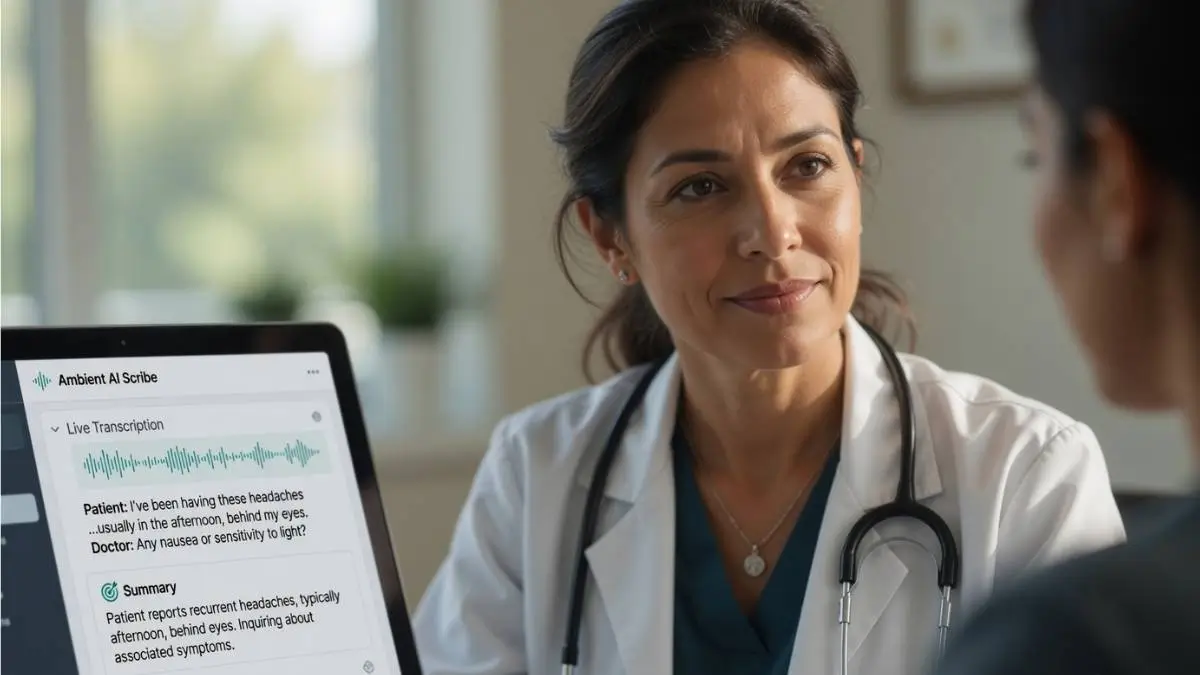
In fact, if you happen to question any healthcare provider, their #1 response to “What really drains your energy?” would probably be paperwork. Yet, the emergence of “Ambient AI scribes” is revolutionizing the situation. These advanced systems monitor the conversation taking place in the doctor’s office, jot down the necessary points, and identify crucial information from the patient’s records. The doctor, instead of having to start from the scratch long after the visit, already has a pretty well-prepared working document. It opens up the possibilities for genuine dialogues with the patients. In 2026, a larger number of medical facilities will be implementing this technology since it not only combats physical and emotional exhaustion but also strengthens the interpersonal touch.
AI agents that get stuff done
We see more ‘agentic’ AI used in healthcare in 2023. This isn’t like a bot. “The agentic AI can see patient information, identify care gaps, mediate between departments, and do basic follow-up. Imagine an AI system that identifies rising BP from home monitoring and then triggers an in person check-up before there is a bigger problem. The secret ingredient? Humans are still in the driver’s seat. AI either writes it up for the doctor/nurse or gives options that the provider will look over and approve. Think of it like a very competent, but not independent, administrative assistant.
Personalized care, again
Personalized medicine is really close to becoming a reality. AI is capable of analyzing genes, lifestyle data, past treatments and even digital replicas of a patient’s body for predicting the most effective treatment. A person, who has high blood pressure for example, will receive treatment options that are the most suitable to their profile rather than the standard approach. These lead the doctors to a point where they can begin their work. They will still meet with the patient, talk over the choices, and take into account factors like the family situation or personal preferences which no algorithm can ever fully capture.
Wearables and regular check-ins
Smart watches and other gadgets are becoming increasingly capable of monitoring heart rhythm sleep physical activity, and several other aspects. Artificial intelligence changes the constant data flow into meaningful notifications. It can detect abnormal patterns which may encourage the user to go to the doctor earlier. This way, we change the nature of care from reactive (“come when you feel bad”) to proactive. But, the information is finally received by a real doctor who assesses it considering the individual’s situation as a whole.
Humans at the wheel
None of this technology will have any benefit if people do not trust it. Now, in 2026, we are seeing a bigger emphasis on openness. Authorities and medical institutions require understandable reasons if AI plays a part in a suggestion. Healthcare workers are learning both the opportunities and limitations of these solutions. At present, lots of the systems include “human-in-the-loop” monitoring so that a qualified individual must approve any major decision. The motive is quite straightforward: employ AI to assist in lowering mistakes and the workload, rather than taking over the professional who is still the main element of healthcare.
What this means for you
As a patient, you should prepare for your doctor to be more focused during the visits You may having a doctor who is well-informed of your medical work and even have more time with you discussing your issues. AI-based tools may help you get the responses quicker Still, the human is the one with whom you have the significant conversation.
For those in healthcare, the idea is less work related to paperwork and more enthusiasm to the parts of the work that are the most important. Problems do exist, of course. Data confidentiality, making sure AI doesn’t lose subtleties, and also making sure that the smaller clinics can afford the good tools are the things that need to be tackled. The ones who make it consider AI as a very strong teammate, not a magic solution.
Looking forward
The balance is shifting in healthcare right now, and 2026 is going to find the sweet spot. AI can work at a scale and at a speed human beings can’t, but doctors and nurses have the intuition, the relationships and the accountability to humans that we don’t yet have in machines. Because when you put them together, care becomes both more intelligent and more human all at the same time, and that’s what is making so many things possible right now.

Digital entrepreneur and content expert I help businesses with AI, SEO and the latest tech trends. I started Silicon Valley Weekly to make complex tech concepts easy to understand and use for business growth. I know a lot about systems and help startups, entrepreneurs and brands navigate the fast-changing world of tech and online marketing.
I build strategies that use data, search optimization, content marketing and AI tools to get visibility, engagement and revenue. I love finding ways for businesses to grow increasing their presence and turning new ideas into successful businesses. My goal is to connect the technology, with practical business use so brands can succeed online.