
What Is Business Management?
To run a business well and efficiently, business administration means managing and overseeing the people, resources, and operations of the business. It includes a lot of different tasks, such as making decisions, planning strategically, allocating resources, and coordinating different parts of the business. The main goal of business administration is to make sure that all parts of a business, like finance, marketing, human resources, and operations, work together well. To help businesses grow and stay in business, professionals in this field look at data, solve problems, lead teams, and adjust to changes in the market.
Business administration is very important in all kinds of organizations, from small startups to big companies, nonprofits, and government agencies. People often use the terms “administration” and “business management” interchangeably, but there are some small differences. Administration usually focuses on bigger picture and strategic issues, while management may focus more on day-to-day tasks and leading a team. In reality, the terms are very similar, and both try to get the best performance possible.
The history of business administration
Business administration has its roots in ancient civilizations that kept simple records and traded goods. However, the field became more formalized during the Industrial Revolution in the 18th and 19th centuries. As factories got bigger, they needed to be run in a more organized way. In the early 1900s, Frederick Taylor’s scientific management brought in time-motion studies and efficiency principles. It stressed standardized processes over giving each worker their own freedom.
Henri Fayol’s five functions of management—planning, organizing, commanding, coordinating, and controlling—added to the field of administrative theory. The human relations movement of the 1930s, which was based on Elton Mayo’s Hawthorne studies, changed its focus to employee motivation and social factors. After World War II, sociotechnical systems and globalization made the field even more advanced. In 1908, Harvard Business School started the first Master of Business Administration (MBA) program. This was a big step forward in professional education. Business administration now includes ethics, technology, and sustainability as part of its framework.
Key Roles and Areas of Business Administration
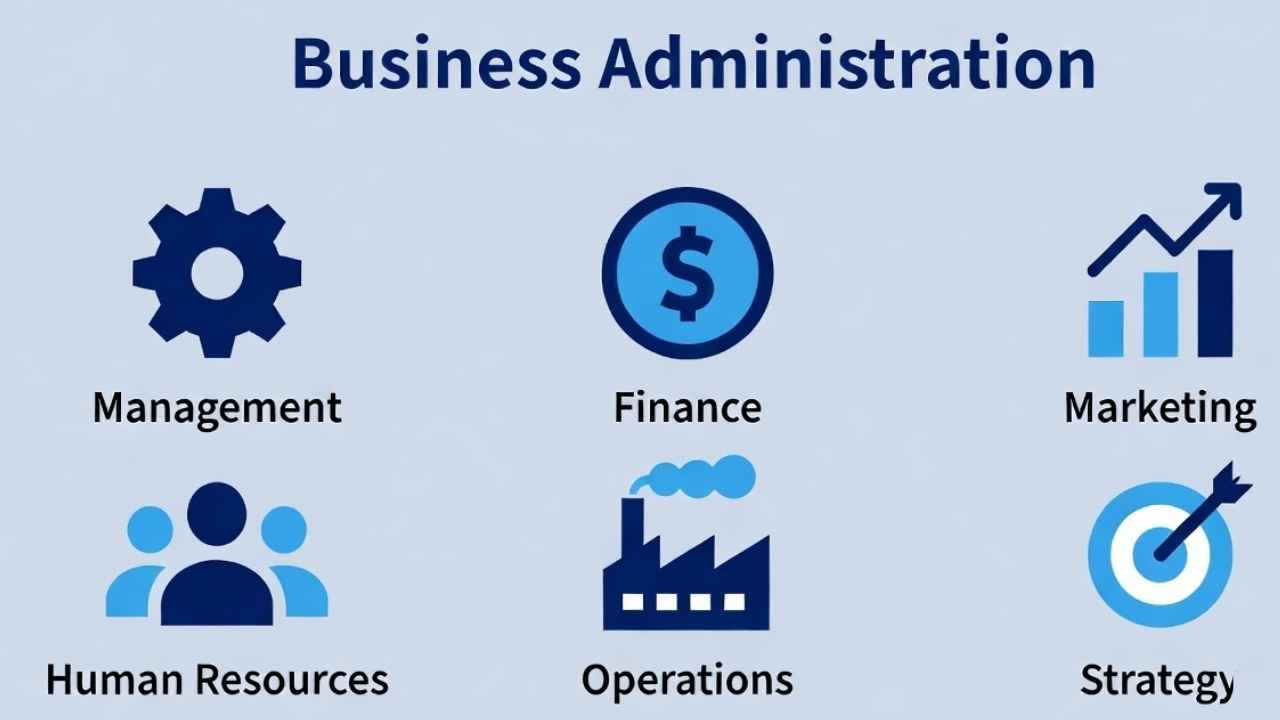
Business administration includes a number of related tasks that help businesses run smoothly. Finance and accounting include making budgets, analyzing finances, making investment decisions, and making sure that rules are followed. Marketing is all about figuring out how people act, coming up with branding plans, doing market research, and getting the word out about goods and services.
HR is in charge of hiring, training, managing employees, and creating a good work environment. Operations management is in charge of quality control, production processes, supply chain logistics, and making things run more smoothly. Strategic planning brings these things together by setting long-term goals, looking at the competition, and changing plans when things outside of the business change, like when the economy changes or new technology comes out.
Information technology and data analytics have become more and more important. Tools like business intelligence software let you make decisions based on data. Ethics and the law make sure that businesses act responsibly, which includes things like corporate social responsibility and risk management. These functions don’t work in a vacuum; good administrators combine them to make the whole organization work better.

What You Need to Know to Succeed in Business Administration
People who work in business administration need to be able to do a lot of different things. To understand financial data, market trends, and performance metrics, you need to be able to think analytically. Strong communication skills make it easier to write clear reports, work with others, and get stakeholders involved. Leadership and people skills help you get people to work hard and settle disagreements.
The best administrators can solve problems and make decisions quickly, and they can also adapt to environments that change quickly. Being good with software tools, project management methods, and basic coding or data visualization makes you more effective. In globalized markets, it is very important to have good moral judgment and be aware of other cultures. You can improve many of these skills by getting real-world experience, doing internships, and learning new things all the time.
Ways to learn about business administration
A career in this field starts with an education. An associate’s degree gives you basic knowledge and can help you get your first job. Most Bachelor of Business Administration (BBA) programs last four years and cover important topics like accounting, economics, marketing, finance, operations, business law, and organizational behavior. Students often focus on areas like finance, marketing, human resources, international business, or starting their own business.
Master’s degrees, like the well-known MBA, teach advanced skills in leadership, strategic management, and other areas. Online and hybrid formats have made it easier for working professionals to move up in their careers. The curriculum mixes theory with real-world examples, like case studies, group projects, and capstone experiences. Getting accredited by groups like AACSB makes sure that the quality is high.
Business Administration Compared to Other Fields
Business administration is different from other, more specific fields because it looks at the whole picture. Accounting is mostly about keeping track of and reporting on money, while administration uses money in a wider range of tasks. Marketing degrees focus on understanding customers and running campaigns, but administrators use marketing as part of a bigger plan. Management often focuses on leadership and interpersonal skills, while administration is more about overseeing operations and functions.
Entrepreneurship programs focus on coming up with new ideas and starting new businesses, which is a part of administration. Students who major in information systems or supply chain go deeper into certain technical fields. A degree in business administration gives graduates the freedom to change jobs and industries.
Job Options and Paths
A degree in business administration can lead to many different jobs. Entry-level jobs are business analyst, administrative assistant, or sales coordinator. A project manager, HR specialist, marketing coordinator, or operations supervisor are all examples of mid-level roles. Operations director, financial manager, chief executive, or consultant are all examples of senior positions.
Healthcare, finance, manufacturing, technology, retail, education, and government are all examples of industries. Salaries can be anywhere from $50,000 for entry-level jobs to six figures for executives, depending on the person’s experience, location, and role. Graduates can start their own businesses with entrepreneurship. There are many ways to grow in this field, and getting certifications like PMP (Project Management Professional) or CPA (Certified Public Accountant) can help your resume.
How Business Administration is Important in Today’s Companies
In today’s competitive world, good business management leads to efficiency, new ideas, and the ability to bounce back. It helps businesses deal with problems like economic uncertainty, problems with the supply chain, and problems with technology. Administrators make the best use of resources to cut costs, make customers happier, and encourage environmentally friendly behavior.
Globalization requires people to be able to work with people from different cultures and come up with international strategies. Ethical administration earns the trust of stakeholders and lowers risks. Strong business administration helps businesses grow in a responsible way, which leads to more jobs, a stronger economy, and a better society.
New trends and the future of business administration
As of 2026, a number of trends are changing the field. AI and data analytics are changing how decisions are made. Agentic AI automates everyday tasks and gives predictive insights. Sustainability and following environmental rules have become more important, which has led administrators to include green practices and ESG (Environmental, Social, Governance) standards in their plans.
New ways of managing teams and measuring productivity are needed for remote and hybrid work models. Even though the world is changing politically, globalization is still going on. This means that supply chains need to be strong and digital tools for working together need to be used. Business schools are putting AI into all of their classes and focusing on how to use it ethically, how to be strong, and how to lead with a purpose.
To stay relevant, administrators need to be open to learning new things all the time. The growth of e-commerce, fintech, and personalized customer experiences makes it even more important to have professionals who are flexible and know how to use technology. For future success, it will be important to find a balance between technological progress and leadership that puts people first.
Conclusion: What Business Administration Means
Business administration is more than just filling out forms and going to meetings; it is the strategic engine that moves organizations forward. It takes a mix of analytical rigor, creative problem-solving, and empathetic leadership to plan for long-term growth and manage day-to-day operations. As businesses become more complicated in the digital age, they will always need skilled administrators.
You can make a real difference in this field by getting a degree or gaining experience on the job. People who want to be professionals should work on building a strong base in the main fields while also learning to be flexible and aware of ethics. In a world where everything is connected, good business management not only helps a company do well, but it also helps the economy and society as a whole.