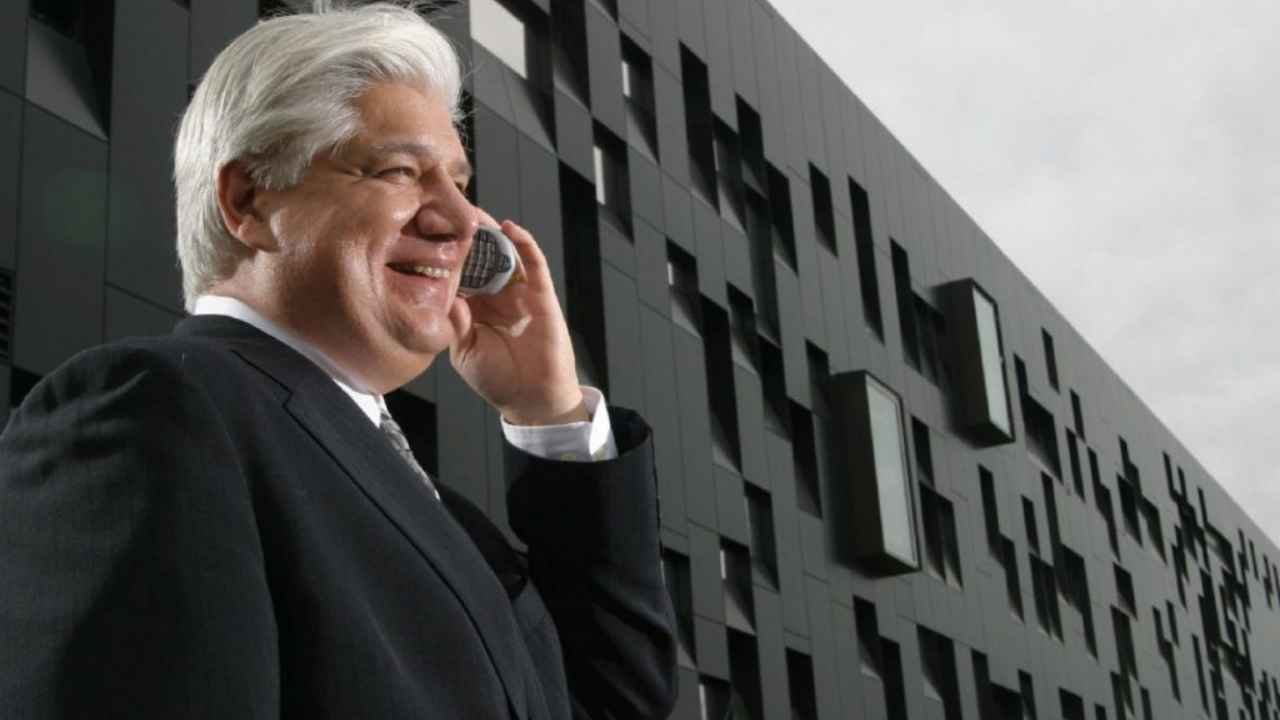
Mike Lazaridis is a well-known Canadian businessman. He is best known for being the co-founder of Research In Motion (RIM), the company that made the famous BlackBerry smartphone. Lazaridis was born on March 14, 1961, in Istanbul, Turkey, to Greek parents. When he was five, he moved to Canada and settled in Windsor, Ontario. His early interest in technology and electronics set the stage for a career that changed the way people communicate on mobile devices and later moved on to advancing quantum science. He is still an important person in innovation, charity, and cutting-edge research at the age of 64 (in 2026) through businesses like Quantum Valley Investments.
Life and Schooling as a Child
Lazaridis was raised in a working-class family in Windsor, where his father’s job as a tool-and-die maker taught him how to solve problems in a practical way. He was very interested in science and technology from a young age. He read a lot of books about electronics from the local library. He did very well in a tough engineering program in high school that included auto shops, architectural facilities, and mechanical drafting. This environment encouraged his creative side, which led him to make devices and play around with circuits.
Lazaridis started studying electrical engineering at the University of Waterloo in 1979. This school is one of Canada’s best for technology. But soon, his desire to start his own business took over. He and his friends Mike Barnstijn and Douglas Fregin started thinking about business ideas while they were still in school. Lazaridis dropped out of school in 1984, just a month before graduation, after getting a $600,000 contract from General Motors of Canada to make an LED notification display system for factories called the “Budgie.” With the help of a contract, a small government grant, and a loan from his parents, he started Research In Motion (RIM) that same year in Waterloo, Ontario.
The Beginning of Research In Motion and BlackBerry
RIM began as a small company that worked on wireless technologies and automation in factories. Lazaridis got an Oscar for technical work and an Emmy for contributions to the film industry for early projects like a digital bar-code reader for film editing. By the end of the 1980s, RIM had switched to wireless data transmission, a field that was still new at the time because most homes didn’t have personal computers.
The BlackBerry, which came out in the late 1990s, made Lazaridis’s vision clear. The device, which came out in 1999, was the first to offer secure, push email and wireless communication in a small, portable form. Business people couldn’t live without it because of its real QWERTY keyboard, long battery life, and reliable messaging. People quickly started to think of the BlackBerry as a way to be productive while on the go. It got the nickname “CrackBerry” because it was so addictive.
Lazaridis was the co-CEO and co-chairman of RIM, and under his leadership, the company grew from a small startup to a global powerhouse. The company’s market capitalization hit $85 billion in 2008, making Lazaridis one of Canada’s richest people, with a net worth that was once thought to be in the billions. He was in charge of product strategy, research and development, and manufacturing from 1984 to 2012. During that time, he got more than 30 patents in wireless technology.
Problems at BlackBerry and leaving
Touchscreen smartphones, especially Apple’s iPhone in 2007 and Android devices, made life very hard. BlackBerry’s focus on security and business features didn’t do well against consumer demand for apps, multimedia, and a sleek design. Market share quickly fell, and RIM (now known as BlackBerry Limited) saw big drops.
Lazaridis and Balsillie quit as co-CEOs in January 2012 because of growing pressure. Lazaridis was vice chair and chair of the innovation committee for a short time before leaving the board for good in 2013. The company’s problems were a big drop from being the best, but there is no doubt that Lazaridis played a big part in starting the smartphone industry. People often call him the “father of the BlackBerry,” and Jay Baruchel played him in the 2023 movie BlackBerry, which dramatized his contributions.
Change to Quantum Science and Giving
After BlackBerry, Lazaridis used his love of basic science to start projects that changed the world. He was a lifelong supporter of basic research and thought that physics could lead to new, game-changing technologies. In 2000, he started the Perimeter Institute for Theoretical Physics in Waterloo with a personal donation of $100 million (which later grew to over $170 million). The institute is now the best place in the world for theoretical physics, drawing the best minds to think about the universe.
He also started the Institute for Quantum Computing (IQC) at the University of Waterloo and gave it more than $120 million. He also helped the Quantum-Nano Centre. These efforts were meant to create a “Quantum Valley” in Waterloo, similar to Silicon Valley but focused on quantum information science.
Lazaridis and Douglas Fregin started Quantum Valley Investments (QVI) in 2013 with a promise of $100 million. QVI gives money and advice to help businesses use quantum breakthroughs in materials, computing, and sensing. Recent events include the Quantum Valley Ideas Lab, which opened in 2016 to speed up the use of quantum technology in real life.
Past and Present Activities
As of 2026, Lazaridis is still the managing partner of QVI and the founding chair emeritus of the Perimeter Institute. He was honored for his important role at Perimeter’s 25th anniversary gala in September 2025. He also announced the Ray Laflamme Early Career Chair in Quantum Computing to honor a late colleague and help new researchers.
He has received many honors for his charitable work, such as being named an Officer of the Order of Canada, an Officer of the Order of Ontario, a Fellow of the Royal Society (FRS), and an honorary doctorate. His net worth is thought to be between $600 million and more than $1 billion, which is a lot of money because he still owns a lot of BlackBerry and quantum ventures.
Lazaridis’s story, from being an immigrant from Turkey to becoming a tech pioneer and science supporter, is a great example of Canadian innovation. He changed the way people talk to each other, and now he puts money into technologies that could change reality itself through quantum mechanics.

Digital entrepreneur and content expert I help businesses with AI, SEO and the latest tech trends. I started Silicon Valley Weekly to make complex tech concepts easy to understand and use for business growth. I know a lot about systems and help startups, entrepreneurs and brands navigate the fast-changing world of tech and online marketing.
I build strategies that use data, search optimization, content marketing and AI tools to get visibility, engagement and revenue. I love finding ways for businesses to grow increasing their presence and turning new ideas into successful businesses. My goal is to connect the technology, with practical business use so brands can succeed online.