
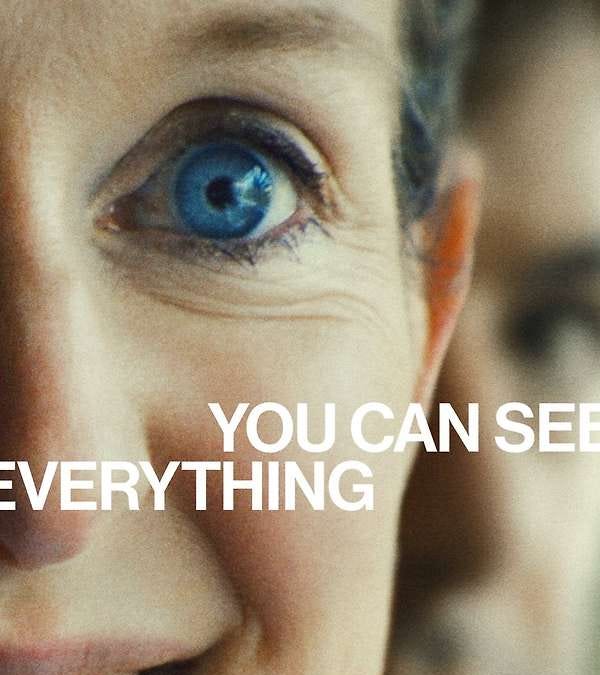
In a world where every celebrity is curated and every controversy is turned into a mini-series, You Can See Everything from Nathan Fielder and Lance Oppenheim is a rare and unnerving documentary that offers full access. This near three-hour long documentary from A24 starts with an almost far-fetched scenario. Just 34 days before Elizabeth Holmes’ sentencing to federal prison, the convicted founder of Theranos and her partner Billy Evans invite a sceptical film crew to their small beach house in Del Mar. The pair want the public to finally see the real Elizabeth Holmes.
Elizabeth has become a somewhat iconic figure. Her deep voice, Steve Jobs-style turtlenecks and unfulfilled blood testing machine made her the poster-child for Silicon Valley hubris. But now, she’s also become the inspiration for Amanda Seyfried’s character in The Dropout. By 2023, her story was pretty set. She was a fraud, she was convicted and sentenced. However, Fielder and Oppenheim reject this narrative. The filmmakers enter the home of their guests and begin documenting their journey.
What makes this film incredible is the way the documentary plays with its genre. Fielder, who has always focused on the relationship between reality and performances, becomes part of the story. The awkward filmmaker is in the same room as Holmes and Evans as he tries to push the boundaries of what ‘everything’ really means. Meanwhile, Oppenheim’s camera work is very tight and precise, making the audience feel uncomfortable as they stare directly into the eyes of the subjects.
Despite Holmes claiming she has nothing to hide, she texts the title of the film to the crew. The cameras follow them on their everyday lives. However, it soon becomes unclear if she is just deluding herself, using a strategy or something else. The film never gives a definitive answer. As Holmes faces practical issues after reporting to prison, Seyfried is brought in to perform certain scenes. This allows the film to look at the idea of representation. The boundary between the documentary and the constructed nature of the story becomes even more blurred. The audience can decide how ‘real’ the film really is.
The reaction to this film has been almost unanimous amongst critics. It’s fascinating to watch as it can be quite funny, thanks to Fielder’s deadpan style. Often it’s very haunting too. There’s never any bias towards Holmes as she remains an enigmatic character. Evans is more erratic. Her young children are unaware of the situation and make us feel calm about the situation. The length is a sensible decision. Time has been used as a device. Whilst it initially seems like there is only a short amount of time to document Holmes’ story, it turns into a long period of follow-ups, letters and experimenting with the format. This film goes beyond its original concept and becomes a study on the boundaries of our knowledge.
The film has a wider theme. We live in a culture where everything is documented. Social media has taught us we can see everything. Documentaries and crime stories promise to give us more insight. However, this film shows us that just because we can see everything doesn’t mean we can understand. Even though we can see her in her kitchen, on her walks along the beach, in her everyday life and during the legal process, we still cannot fully understand her. The title of the film is a bit of a joke. Just because we can see everything from the front, doesn’t mean we can understand.
The best thing about this film is how it doesn’t offer any easy closure. There is no smoking gun or redemption arc. Instead it allows the audience to think about how they are feeling about the ambiguity. It makes us realise how our opinions change throughout the film. It also makes us realise how much of the film is constructed. Due to Fielder being involved, we know we cannot see everything from an unbiased perspective. We’re involved. By the end of the film we begin to question what it really means to say we can see everything.
This is one of the most unique and unsettling films of recent years. The documentary acts like a psychological thriller. It’s a performance but also a philosophical study. In a culture where we think seeing everything equals knowing everything, this is a revolutionary film to watch. Go and watch it and try to decide what you’ve actually seen.