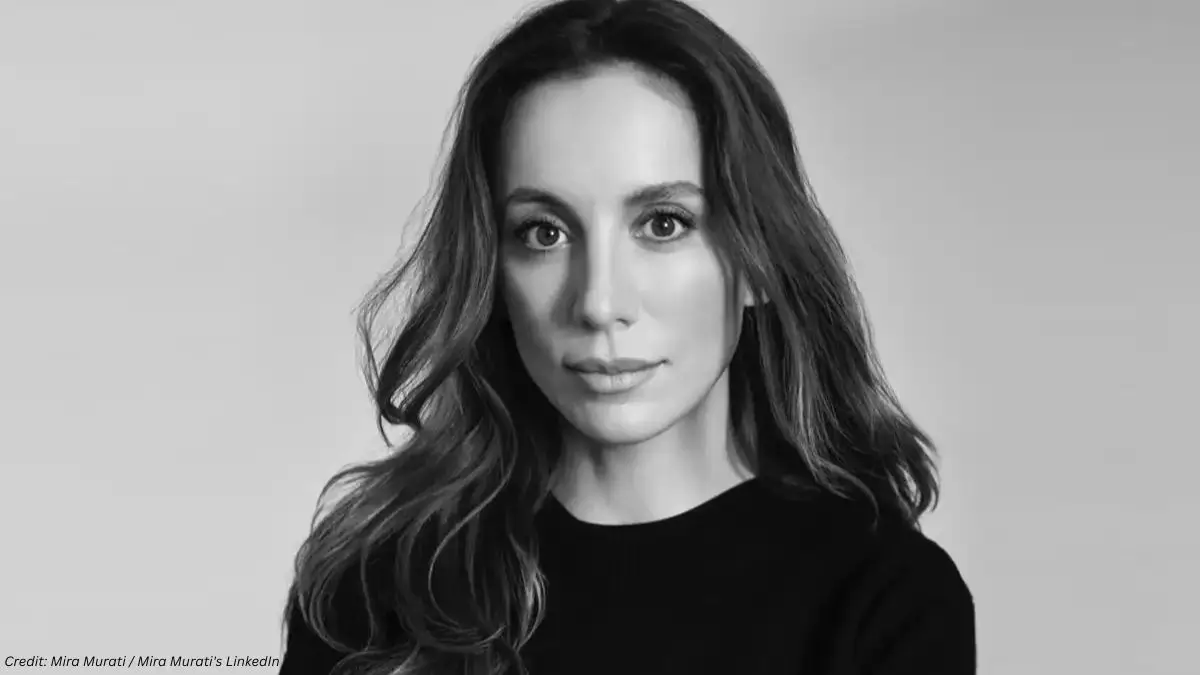
She left one of the most important companies in the history of artificial intelligence without a press release, a going-away party or a clear public explanation. In September 2024, Mira Murati suddenly left her post as Chief Technology Officer of OpenAI, the entity she helped build into a global sensation, and largely went off the grid. Eighteen months later she was back on stage at Bloomberg Tech 2026 in San Francisco, measured and deliberate, leading a company that had already redrawn the boundaries of what an AI startup can achieve in its first year of existence. The company is called Thinking Machines Lab, and its story is the story of the woman who founded it.
Early Life & Education
Ermira “Mira” Murati was born on 16 December 1988 in Vlorë, Albania, in the final years of the country’s totalitarian communist regime. Born into an era of political chaos and economic upheaval, she developed a resilience and intellectual ambition that would define her career. That drive got her a scholarship at sixteen with the Davis United World College Scholars Program, one of the most prestigious international education programs in the world, taking her to Pearson College on Vancouver Island in Canada. She obtained an International Baccalaureate in 2007.
Her academic career was subsequently unusual and farsighted. She didn’t have to choose between the sciences and the humanities. She did both at the same time, earning a Bachelor of Arts in Mathematics from Colby College and Bachelor of Engineering in Mechanical Engineering from Dartmouth College’s Thayer School of Engineering, graduating in 2011 and 2012 respectively. That dual foundation, analytical precision and engineering problem-solving, became the intellectual signature she took with her to every subsequent role.
A Career Based on Foundational Work
Murati was already working on the edges of AI, before it became a household subject. She began her career with a summer internship at Goldman Sachs in Tokyo and then as an Advanced Concepts Engineer at Zodiac Aerospace. In 2016 she joined Tesla as a senior product manager working at the intersection of hardware systems and software intelligence, a discipline that served her well for what was to come.
In 2018 she joined Open AI as Vice President of Applied AI and Partnerships. Over the next six years, she rose through the ranks of the organization to Chief Technology Officer in May 2022, managing the research, product and safety divisions of a company whose products — ChatGPT, DALL-E, Codex, Sora and the GPT series of language models — would transform the way the world understood and used artificial intelligence. Murati served as interim CEO of one of the most watched companies in the world for a brief, turbulent period in November 2023 when the OpenAI board fired CEO Sam Altman in a dramatic governance crisis. Looking back on those five chaotic days, she said the company would have “imploded” without her steadying presence. In October 2023, she was ranked No. 57 on Fortune’s list of the 100 most powerful women in business.
In September 2024, she quietly resigned from the company, after more than six years, without providing a public explanation.
Founder of Thinking Machines Lab
Then, in February 2025, Murati broke her silence with an announcement that instantly caught the attention of the AI industry. She’d started up Thinking Machines Lab, a new public benefit corporation whose mission statement was to make AI systems “more broadly understood, customizable and generally capable.” The team she put together was impressive by any standard: OpenAI co-founder John Schulman signed up as chief scientist, together with Barret Zoph, formerly OpenAI’s VP of Research, Lilian Weng, also formerly an OpenAI VP, and other senior researchers and engineers poached from Meta AI, Mistral AI, and OpenAI itself. Advisors included Alec Radford and Bob McGrew, who were both very influential figures in the world of AI research.
Murati’s governing structure for the company was both intentional and unusual. She has a deciding vote on board matters weighted to give her the majority decision-making capability. Founding shareholders have votes weighted a hundred times greater than those of regular shareholders. The architecture was a statement: this would be her company, built on her principles, free of the kind of board-level instability she had seen at OpenAI.
At the time of its launch the company was already valued at around ten billion dollars. Within a month the valuation, per Bloomberg, had risen to nine billion and the average founder stake was worth 1.4 billion dollars. The AI world was holding its breath.
The Seed Round That Broke Records
In July 2025, Thinking Machines Lab announced the largest seed funding round in the history of venture capital. The round was led by Andreessen Horowitz, one of the most influential investment firms in Silicon Valley, and raised $2 billion at a post-money valuation of $12 billion. The investors were a who’s who of tech capital: Nvidia, AMD, Cisco and Jane Street all participated, as did, in a remarkable footnote, the government of Albania, Murati’s country of birth, which made a ten million dollar investment that necessitated an amendment to the country’s 2025 national budget. It was a symbolic as well as a financial gesture, a small Balkan nation placing a gamble on the daughter it once lost to economic hardship.
The round validated not only Murati’s personal reputation, but also the company’s thesis, that an AI research lab designed as a public benefit corporation, led by a founder with full governance authority, and focused on making AI truly customizable and understandable, not just more capable, was worth backing at the highest levels of the industry.
Tinker: The First Commercial Product
The first product from Thinking Machines Lab shipped in October 2025, and the decision of what to build was telling. Instead of jumping into the fray of consumer-facing AI assistants, the company introduced Tinker, a developer platform that allows running and customizing open source AI models. At its core was a fine-tuning API that allowed researchers and engineers to get inside the model, tweaking algorithms and training data without managing massive computing infrastructure themselves. The approach put Thinking Machines in the position not of another chatbot vendor, but of infrastructure for the researchers and developers building the next generation of AI systems.
The launch coincided with research the company published in September 2025 that claimed current AI models output inconsistently variable results for similar inputs, a fundamental reliability problem, and proposed training techniques designed to lower that variance. It was the kind of foundational technical contribution that marked a lab more interested in pushing the underlying science than racing for product headlines.
Strategic Infrastructure: Nvidia vs. Google
A startup is only as good as its computing might, and Murati moved quickly to lock in infrastructure commitments from the two most important players in AI hardware and cloud services. In March 2026, Nvidia announced a strategic partnership with Thinking Machines Lab that included an undisclosed investment and a multi-year agreement to deploy one gigawatt of Vera Rubin AI accelerator capacity, the next generation successor to the Blackwell architecture. The size of that commitment, to a company less than 14 months old, spoke to Nvidia’s belief that Thinking Machines was building models that would need to be trained at scale on frontier-grade hardware. The following month, in April 2026, Google expanded its partnership with Thinking Machines with a new, single-digit billion dollar deal. The two infrastructure deals together cemented the lab’s position as a serious technical operation, not a well-funded research curiosity.
Interaction Models The Second Product and a Paradigm Challenge
In May 2026, Thinking Machines Lab had its biggest announcement yet. The company announced what it’s calling “interaction models” – a new category of AI that it says solves a fundamental bottleneck in the way that humans and machines communicate with each other. Most AI systems we have nowadays are turn-based: you input something, model waits, processes, responds. This is the architecture behind the Realtime APIs at OpenAI and Google DeepMind, and it has a fundamental problem: the model has no knowledge of what is happening while the user is still speaking or typing.
Thinking Machines Lab’s solution is a model architecture it calls Multi-Stream Micro-Turn Design. The model processes incoming audio, video and text in blocks of two hundred milliseconds, generating outputs in parallel with receiving inputs, rather than waiting for a full conversational turn. What results is what engineers call ‘full duplex’ communication–more like a phone call than a text message exchange. The model can be interrupted mid-response, can catch up on pauses and mid-thought corrections, and can respond to visual and verbal cues in something like real time.
The company’s first model TML-Interaction-Small, responds in 0.40 seconds, about as fast as natural human conversation and much faster than similar systems from OpenAI and Google. It beat GPT-Realtime-2.0 in internal benchmarks, which responds in an average of 1.18 seconds. More pointedly, the firm released benchmarks in which GPT Realtime-2 scored close to zero on metrics measuring cued response timing and temporal action localisation – capabilities that the Thinking Machines architecture was designed explicitly for.
The system remains a research preview at the time of publication, with a wider release planned later in 2026. The company sees applications in surgical suites, manufacturing settings, creative studios and any field where real-time human-AI synchronicity is important. “The way we work with AI is as important as how smart it is,” Murati said at the launch. It’s a sentence that captures the company’s entire philosophy.
Rising to the challenges
No honest history of the first year and a half of Thinking Machines Lab can ignore its turbulence. Bloomberg reported in November 2025 that the company was in talks with investors at a valuation of between fifty-five and sixty billion dollars, roughly four times the seed price in less than five months. The discussions attracted a great deal of attention and a great deal of scrutiny. The financing had not closed by January 2026. The round fell apart, with prospective backers unwilling to support the higher valuation without a stronger commercial track record. For Murati, the episode was a useful marker for where AI investor appetite meets product reality, and she dealt with it by refocusing the company on its original seed valuation, and continuing to build.
Another, more painful challenge came in January 2026. Murati announced publicly that the company had parted ways with Barret Zoph, the co-founding Chief Technology Officer, in circumstances that later reporting linked to serious misconduct. In the same announcement, she also announced the appointment of Soumith Chintala, co-creator of PyTorch, respected across the industry, as the new CTO. Other founding-team members returned to OpenAI or to Meta, which had been aggressively recruiting AI researchers. Murati was typically succinct about the departures during her Bloomberg Tech appearance: creating a frontier AI lab from scratch is a matter of compressing years of normal organizational volatility into a few months, and compensation alone is rarely the whole story. She did not linger over the exits.
The Bloomberg Technology
Murati’s first major public appearance in eighteen months when she appeared at Bloomberg Tech 2026 in San Francisco on June 4 was an occasion of unusual weight. She had, by design, almost entirely avoided the conference circuit and media cycle that preoccupies so many of her peers. She was not returning in a nostalgic way. She took the stage to lay out the technical roadmap for Thinking Machines Lab, to preview the interaction models that would be formally announced days later, and to talk about the question she keeps coming back to: the concentration of consequential decisions about AI in too few hands. “I’m not waking up in the morning thinking about how to kill the competitor,” she told interviewer Emily Chang, to audience laughter. This was no modesty, it was a statement of method.
Awards and Recognition & Next Steps
Murati was named a 2026 Changemaker by CNBC, which cited her as one of the leading minds in the artificial intelligence industry and highlighted her fundraising records and work on behalf of the mission to enable more people to do research with AI. She was named one of the top 100 most powerful women in business in the world by Fortune. She has published scholarly work on language and the creativity of coding in Daedalus, the journal of the American Academy of Arts and Sciences—a fact that suggests the range of her intellectual engagement with the field she is trying to reshape.
As of July 2026, the Thinking Machines Lab is in the second half of its second year. Two products have shipped, two technical frameworks have been published, there are infrastructure agreements with the two largest AI hardware and cloud providers in the world, and two billion dollars in capital. The $50 billion valuation episode is the most visible item in the company’s public record, but the more durable data point is this: Murati kept the original seed valuation, kept her team intact through some of the most aggressive poaching the AI industry has ever seen, and delivered a product roadmap that went from developer tooling to a novel model category in under sixteen months.
Conclusion
In some ways, Mira Murati’s story is the story of a woman who grew up in a small Albanian coastal city, won a scholarship at sixteen, studied both mathematics and mechanical engineering, and eventually helped build some of the most consequential software in human history. On a different level, it is the story of someone who reached the top of one institution, saw with clarity what she saw there, and decided to build something else. Murati said Thinking Machines Lab is a public benefit corporation because AI should serve more than shareholders. It’s focused on customizability and transparency because she believes that AI should be understandable, not just powerful. And it’s chasing interaction models — AI that listens while it talks, that meets humans where they are — because she believes the interface between human and machine is as important as the intelligence behind it.
The next few years will determine whether Thinking Machines Lab is the next great AI company or a formative chapter in a longer story. What is already a certainty is that Mira Murati has built something real, built it on her own terms and built it in a way that no-one else in the industry had tried. In a world where speed and scale are king, that kind of deliberateness is a form of ambition itself.

Digital entrepreneur and content expert I help businesses with AI, SEO and the latest tech trends. I started Silicon Valley Weekly to make complex tech concepts easy to understand and use for business growth. I know a lot about systems and help startups, entrepreneurs and brands navigate the fast-changing world of tech and online marketing.
I build strategies that use data, search optimization, content marketing and AI tools to get visibility, engagement and revenue. I love finding ways for businesses to grow increasing their presence and turning new ideas into successful businesses. My goal is to connect the technology, with practical business use so brands can succeed online.